

Sorkin Barks But ‘The Social Reckoning’ Doesn’t Bite
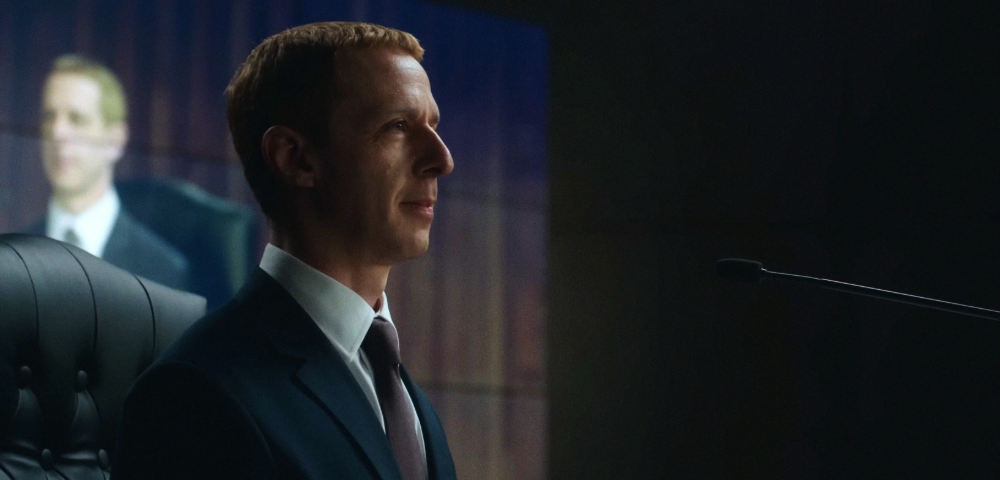
Image: Jeremy Strong as Mark Zuckerberg in 'The Social Reckoning'. Source: TMDB.
A fascinating story bogged down by too much tech-speak and a few too many lectures, *The Social Reckoning* never quite hits as hard as it should.
Written and directed by Aaron Sorkin, the film follows Frances Haugen (Mikey Madison), a Facebook engineer turned whistleblower, and Jeff Horwitz (Jeremy Allen White), the Wall Street Journal reporter who helps expose what the company knows about its own platform. As they dig into Facebook’s algorithms and their role in pushing users towards increasingly extreme content, the film makes for some pretty unsettling viewing. It’s also a reminder of just how little control we have over what these platforms feed us.
The investigation is easily the most interesting part of the film. There’s an eerie feeling to the early scenes, and the mystery of how Facebook’s algorithms work, and what they’re doing to people, is genuinely gripping. But as Frances and Jeff get deeper into it, the conversations start to feel repetitive. The tech-speak gets a bit much, and the film has a habit of spelling out its point when it could just let the story speak for itself. The January 6 insurrection sequence is another example of the film laying it on a little thick, with a dramatic tone that doesn’t quite fit the rest of the film.
Luckily, Madison and White make for a compelling pair. Their chemistry is excellent, and watching their initially reluctant partnership turn into something more trusting is often more fun than the investigation itself. Their banter brings some much-needed humour to a film that can otherwise get bogged down in its own seriousness.
Madison is particularly good as Frances, whose belief in Facebook’s original promise makes turning against the company all the more difficult. The film could do more to show us that conflict rather than just tell us about it, but Madison brings plenty of heart to the role. Her appearance at the Capitol Hill hearing is a highlight.
Jeremy Strong is just as good as Mark Zuckerberg, playing him as an awkward, almost reptilian figure who seems to need coaching through basic human interactions but has no trouble keeping his eye on the bottom line. The supporting cast is strong too, from Betty Gilpin’s ball-busting editor to Wunmi Mosaku’s crisis expert, with plenty of good performances filling out the world around the two leads.
The bigger issue is Sorkin himself. His rapid-fire dialogue and arguments about right and wrong are still entertaining, and some of the exchanges genuinely land. But the writing can get smug, with characters talking at each other as if they’re competing to deliver the sharpest take. The direction doesn’t do much to help. For a story about something as big and unsettling as social media radicalisation, The Social Reckoning feels surprisingly static. The editing can be clunky, the timeline jumps don’t always work, and the score ends up doing a lot of the heavy lifting.
Still, the story matters. Watching journalists and whistleblowers try to hold a powerful company accountable is compelling, even when the film leaves you wondering what, if anything, has actually changed. That frustration isn’t necessarily a failure of the film’s subject, but it does make the whole thing feel a little bleak.
The Social Reckoning is perfectly watchable, with a stellar cast and a story worth telling. But it never escapes the shadow of The Social Network. A clunky, somewhat unnecessary sequel with plenty to say, but not quite the cinematic chops to make us feel it.
3/5
The Social Reckoning is in cinemas now.








Leave a Reply