Meet Three Sydney Artists Featured In Bondi’s Sculpture By The Sea Festival 2026
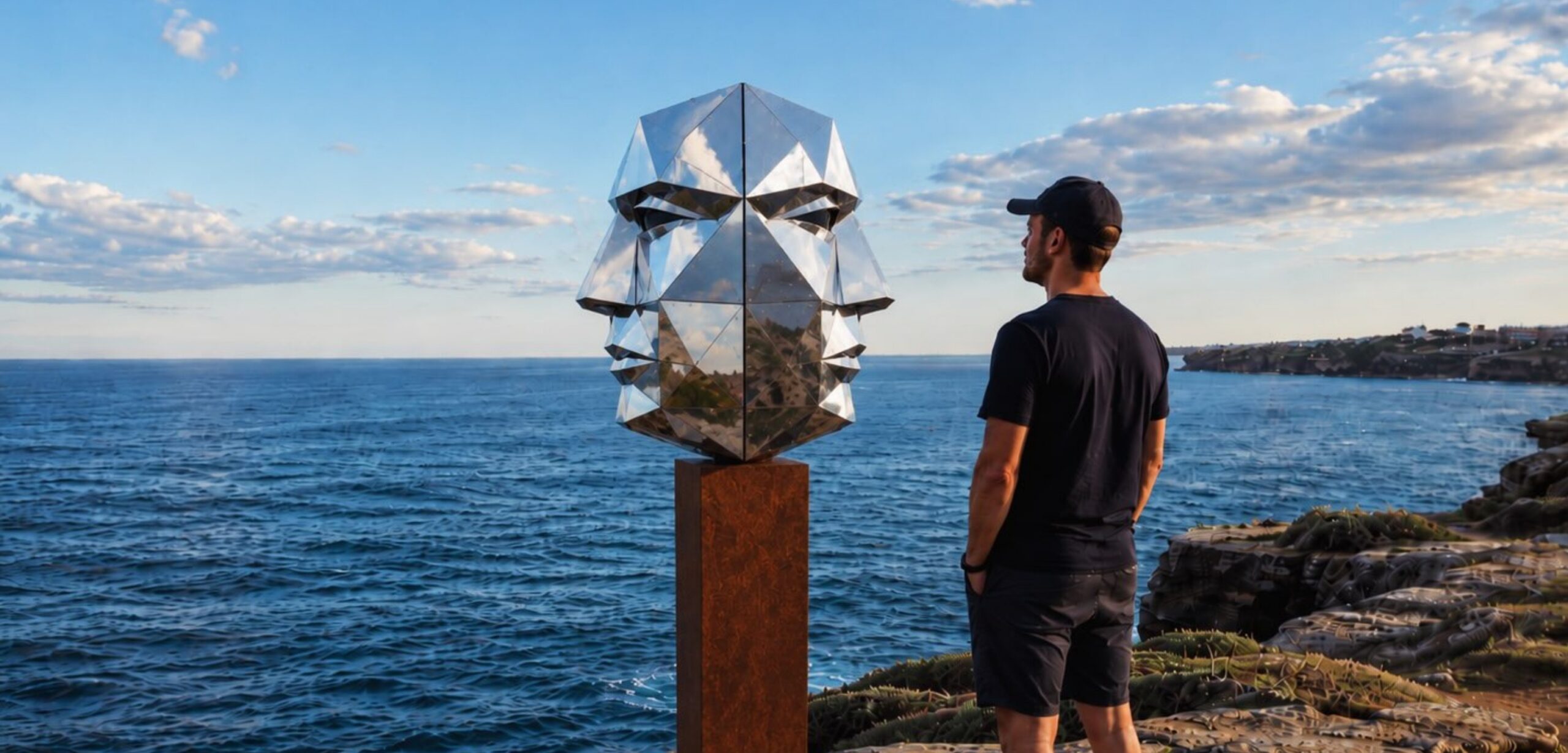
Image: @paulewart / Instagram
In just ten days, Sydney’s annual Sculpture by the Sea will return for its 30th installment. Running from 16 October until 2 November, the festival will once again transform Bondi’s iconic coastal walk into a 2km long, free public exhibition.
While the oceanside cliffs are arguably an artwork in their own right, what better time to visit this salt-sprayed scenic route than when the trail is also dotted with some of the most challenging, absurd, and amusing objects made by human hands in 2026.
Of course, you don’t have to take our word for it. Today we’ll be hearing from three of the spectacular Sydney artists to be featured in this year’s festival, who will explain exactly why their donation to the exhibition is not to be missed. Care to join us?
Meet Bondi Designer & Artist Nathan Don, AKA ‘Procrastinatedon’
Have you ever dreamed of paying five cents to step into a shipping container and admire a grain of sand? Neither have I. But according to Bondi artist Nathan Don, AKA Procrastinatedon, it is “without question, the greatest grain of sand you will ever pay to see”.
According to the 32-year-old UNSW Art & Design alumni, ‘Procrastinatedon’ is the art he makes when he is meant to be running his brand studio, HandToMouse.
“I’m not very good at drawing,” Nathan told CityHub. “Pottery went worse. Woodwork went worse again. So my medium is whatever the idea needs. In 2024 it was a line on the path at Sculpture by the Sea, called White Line Therapy. This year it’s a shipping container and a grain of sand.
“Calder is the mobile guy. Pollock is the splatter guy. Picasso is the cubism guy. I would like to be the dumb art guy.”
But Nathan…Why That Specific Grain Of Sand?
When asked why this particular grain of sand was so significant, especially given its display mere metres away from about a quadrillion more, Nathan did not hesitate.
“It’s The World’s Greatest Grain of Sand,” Nathan said. “I’d rather not get into how it was chosen.”
The grain of sand lives in a 20-foot shipping container at Marks Park, where viewers can pay to enter the prestigious receptacle.
“Gilded frame, glass, velvet, proper lighting, brass stanchions, brass sign,” said Nathan. “Everything a masterpiece is entitled to. Entry is five cents and you get fifteen seconds inside. That is plenty.”
Clearly lacking whatever secret sand-connoisseur knowledge Nathan proudly holds, this masthead simply had to ask him what inspired the piece.
“In Year 8 my art teacher showed us Man Ray’s The Gift,” Nathan recalled. “I thought it was fascinating in exactly the same measure as I thought it was dumb. This year I finally saw it up close. It is tiny. Still dumb. That dumb and fascinating feeling is the one I hope people have in front of my work.
“As for why Sculpture by the Sea: I walked it during my HSC, listening to my study notes, never once thinking I could be in it. In 2024 I heckled a staff member into putting a line on the path. That is how I became an artist by accident. It worked, sort of. Being a one-trick pony is fun, but unfortunately I keep having more ideas.”
Meet Bondi Beach Journalist & LGBTQ+ Artist Paul Ewart
While Nathan pays tribute to a natural gem, namely the kind you can’t seem to get out of your car, our next artist has chosen another kind of shard, a fragmentation instead made by man.
In Both Sides Now, 20-year career journalist Paul Ewart transfers his extensive knowledge of conflict, competing perspectives, and political polarisation into something unexpected: a gigantic, dual-faced head made entirely out of mirrors.
View this post on Instagram
According to Paul, the 3-metre-high head of the two-faced Roman god Janus — created with facets of highly polished, mirrored steel — aims to explore a fractured political landscape, one where perspectives are narrow, polarised, and devoid of empathy.
“Through faceted mirror planes, the sculpture explores the collapse of common ground,” Paul told CityHub. “Though Janus looks in opposite directions simultaneously, each face is physically unable to see the other’s perspective. As viewers walk around it, its polished surfaces reassemble their reflection alongside the sky, the ocean, and the surrounding crowd.”
An Artwork Inspired By A Childhood Of Anti-LGBTQ+ Prejudice
For Paul — who has interviewed everyone from Hugh Jackman, Chris Hemsworth, and Katy Perry to Holocaust survivors and global explorers — the piece isn’t just a product of decades of rigorous journalistic observation. Rather, much of it was inspired by personal experience.
“While the piece tackles what I believe is the most urgent issue we face globally—the erosion of middle ground and the tightening grip of ideological polarisation—it’s also a deeply personal, local story,” Paul said.
“Having grown up gay in a small town and attended a fundamentalist Christian high school, I know all too well what it feels like to be on the receiving end of extreme prejudice and dogmatic division.
“Both Sides Now is born directly out of that lived experience, using mirrored surfaces to force a moment of shared reflection where the viewer’s own image merges with the landscape and the people around them.”
According to Paul, the hope is that the artwork will pose a simple yet urgent question to those who pass by it: “Can we still hold space for nuance, empathy, and opposing truths?”
“While the piece wasn’t created specifically around the anniversary of the Bondi terror attacks, its message of lost middle ground, prejudice, and the need for human connection feels deeply poignant right now,” Paul said.
“Living here, you feel how profoundly recent events have impacted our community. Placing a reflective piece on the coastal path offers a quiet, organic space for shared pause, asking us to look at one another with renewed empathy and understanding.”
Meet Sydney Designer, Artist, & Unapologetic Wheelchair User Julian Pereira
Our final artist to be featured in this year’s Sculpture by the Sea is none other than Julian Pereira. A 2015 Design in Architecture graduate from the University of Sydney, Julian’s work largely explores ideas of accessibility and inclusion in public space. His latest sculpture is no different.
In Atlas (The Endurer), Julian reimagines the Greek Titan as a dad lifting a pram, the steel-cut stick-figure distinctly resembling the minimalist motifs found on toilet and accessibility signage. According to Julian, the artwork is designed to invite audiences to consider how people respond when built environments create barriers.
View this post on Instagram
“The idea grew from seeing parents and carers carry prams up and down the stairs along the Bondi to Bronte coastal walk, where the route can make access difficult,” said Julian.
The work will appear in Sculpture by the Sea alongside The Thinker, both sculptures a collaboration between Julian and fellow artist David Da Costa Enes. According to Julian, both artists were deeply inspired by having encountered obstacles to their own accessibility requirements.
“David and I approach these themes from different lived experiences: I’m a wheelchair user, and David is a father to a young daughter. The works bring those perspectives together through simple images that we hope people can recognise and connect with.”
“I hope the works prompt people to ask who carries the burden when public spaces aren’t designed for everyone. We often admire people for their resilience, but sometimes that resilience is needed because the environment has made an ordinary journey unnecessarily difficult.
“There’s something a little tongue-in-cheek about seeing Atlas struggling under the load of a pram. It gives people a way into the work before the bigger questions about access and how we design public spaces begin to unfold.”
Leave a Reply