

‘Tony’: A Hearty Coming-Of-Age, Under The Guise Of A Biopic
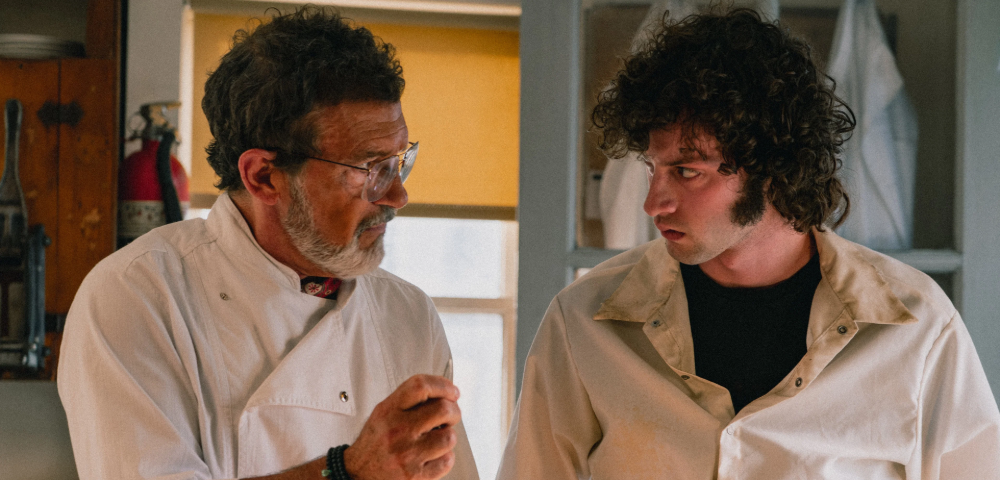
Image: Dominic Sessa and Antonio Banderas in 'Tony'. Photo credits: TMDB
A coming-of-age story with a complicated culinary icon at its centre, Tony is a heartfelt and sweltering portrait of Anthony Bourdain before the legend, when he was mostly just a cocky insecure snot who needed to find something worth caring about.
Simple but effective, it’s a good story that just happens to be a biopic, grounded by fantastic performances and a quietly winning character arc.
Directed by Matt Johnson, Tony drops us into the young Bourdain’s life after he is rejected from a writing fellowship and follows a girl to Providence, a summery seaside town.
He starts washing dishes, and spinning increasingly desperate lies, until he can no longer avoid facing himself.
Simplicity is the film’s greatest strength. Straying from a typical biopic narrative (tragic backstory, grand rise-to-fame, lazy references and so on), Tony’s story foregoes the man behind the myth of it all with a charmingly effective coming-of-age story.
Dominic Sessa‘s Tony is just a kid with a huge opinion of himself and very little to show for it, unnecessarily explaining Latin words, embellishing his achievements and constantly lying to people for his own gain.
It’s far from a flattering introduction, with the film even opening with a ‘Kitchen Confidential‘ quote, Bourdain describing his younger self as arrogant, full of himself and desperately in need of an ass-kicking.
Yet what begins as irritating gradually becomes compelling and even worth rooting for.
And that arc is skilfully landed with a plethora of stellar performances. Sessa is a terrific lead, particularly in how effortlessly he embodies Tony’s combo of try-hard charm, arrogance and insecurity, letting him be a dick without making him irredeemable. He can be an absolute loser one minute and oddly magnetic the next, gradually revealing a resonant vulnerability beneath the façade.
There is no grand epiphany, just a gradual shift from performing a version of himself to actually becoming someone.
His mentor, a once-renowned chef played with gruff warmth by Antonio Banderas, owns the screen. Their relationship anchors the film as he helps Tony discover the empathy and connection that can come from food, while cooking gives his restless ambition somewhere to land.
Equally attention-grabbing is Leo Woodall as Sal, a lazily smiling storm of drugs, hookups and bad decisions who initially takes Tony under his wing. Woodall carries the grittier energy of the film, a magnetic but rotten influence, embodying the darker path Tony could easily have taken.
The rest of the ensemble is just as excellent throughout, with easy banter and chemistry making the restaurant feel lived in.
Thoroughly showing his range, Johnson gives the film a warm, grainy intimacy, capturing the hot summer night atmosphere of Providence.
And kinetic editing and brisk pacing keep things moving without making it feel frantic or flattening quieter moments.
The romance, however, is the one conspicuously undercooked element. The chemistry is warm enough, but it’s hard to buy that Emilia Jones‘ Nancy is so completely fooled by Tony when we’ve seen him lie through his teeth, even getting called out for it in front of her.
It feels less like a deliberate character contradiction than a screenplay convenience.
Tony takes plenty of liberties with Bourdain’ actual story, conflating characters and reshaping events. But rather than an info dump of a Wikipedia page, the focus on a singular chapter of the chef’s life allows the film to thrive and firmly stand out in a sea of biopic fatigue.
Even without knowing Bourdain, there is something universal here: the messy, uncomfortable process of finding yourself by finding something you genuinely love.
Charming, funny and deliberately simple, Tony may not be revelatory but it is an unexpectedly great story that just happens to be a tribute.









Leave a Reply