
‘My Cousin Frank’ Hits Hard With Legacy, Loss And Masterful Storytelling
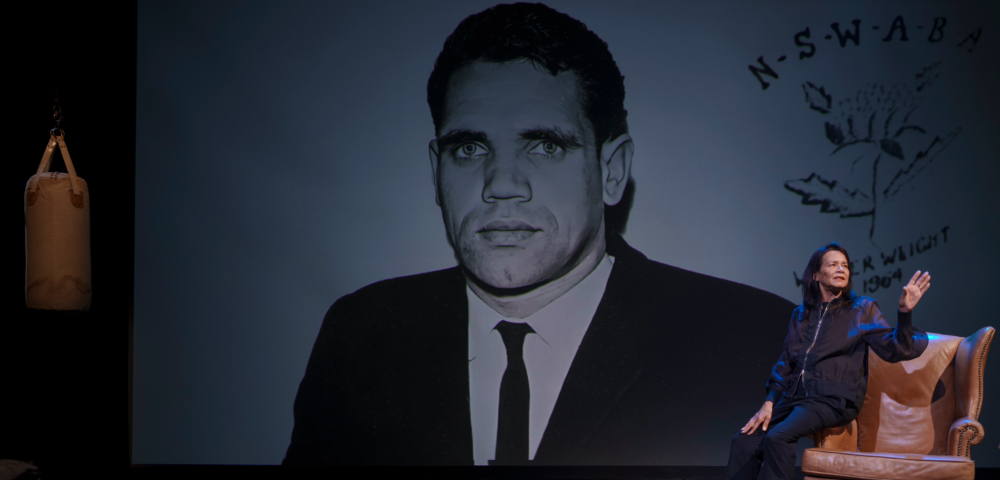
Image: Rhoda Roberts AO in 'My Cousin Frank' at Sydney Opera House. Source: SOH / Credit: Stephen Wilson Barker
My Cousin Frank is an intimate, gripping hour of storytelling that turns one man’s history into a vivid act of cultural remembrance.
Written and performed by Rhoda Roberts AO, the show traces the life of her cousin Frank Roberts, a Widjabul Wia-bal and Githabul man from Cubawee, near Lismore.
Before he became Australia’s first Aboriginal Olympian, Roberts roots him in Country, kin and the rhythms of Budjalung life strained by government control.
She guides the audience through WWII-era anxieties to Frank’s journey from rural New South Wales to the 1964 Tokyo Olympics, where he boxed on the world stage and dined with Emperor Hirohito.
Despite the achievement, he travelled without an Australian passport, denied citizenship by the government whose colours he was representing..
At its heart, the show is a portrait of ‘Honest Frank’, whose discipline in the ring shaped his life beyond sport.
Roberts situates that life within dispersal and cultural amnesia, most starkly when the Aborigines Protection Board bulldozed Cubawee as an ‘eyesore’ while Frank was overseas, erasing an entire community in an afternoon.
Heartbreak hangs in the room, yet Roberts balances grief with charm, pride and inherited resilience.
Across a tight 75 minutes, Roberts approaches the material with warmth and a firm sense of responsibility.
Her storytelling is conversational and inviting, like sitting around a firelit lounge with an aunt who knows exactly how to hold a room with a spark in her eye and a razor-sharp timing.
Sprawling family trees and nostalgic riffs arrive between sips of her ‘everyday black’ tea.
At times she slips into her grandfather’s voice, “Stand tall. Head up. High up,” a phrase that becomes a steady pulse echoing through the show and Frank’s life.
She brings to life the tapestry of a family marked by boxers, matriarchs and pastors with emotional heft and enough dry humour to keep it buoyant. The narrative flows easily between memories and eras with ease, showing how one man’s path reflects wider First Nations experiences of racism and erasure.
Roberts effortlessly weaves these stories with care, and her intimacy keeps the scale from ever feeling abstract.
A few early stumbles come from nerves rather than uncertainty but nothing that detracts, instead folding into the brisk rhythm without losing connection. Roberts has the presence that makes an audience lean in.
Production design is simple and effective. A tall leather chair anchors the space like a storytelling throne, paired with a small side table of books and a brass teapot. A boxing bag and gloves rest nearby, with occasional taps from Roberts, recalling Frank’s presence.
Projections of swaying trees, family photos and sounds of corroboree add atmosphere without distracting from Roberts voice.
The show is a must-see story, especially for those who value narrative theatre, untold histories and theatre that prioritises memory over spectacle.
More than a tribute, My Cousin Frank tells of a mob weathering erasure and honours an overdue hero who gave much to a country that barely saw him.
Roberts shapes his legacy into one of the most quietly moving First Nations works on stages, reminding us that stories and hope endure only when people carry them forward.
My Cousin Frank ran at Sydney Opera House till 6 December.