Dharawal and Yuin sculptor Alison Page, whose work adorns Captain Cook’s landing site in Botany Bay, has been commissioned for a monument at Circular Quay which will honour Indigenous women.
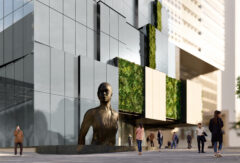
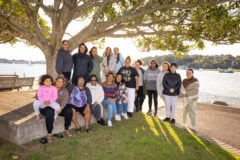
The artwork, titled Badjgama Ngunda Whuliwulawala (Black Women Rising) and designed with the input of the newly-formed Sydney Coastal Aboriginal Women’s Group, will embellish a public square outside of the under-construction One Circular Quay residential tower. Page was commissioned by Lendlease, the building’s developer.
Portraying a figure part human and part whale, she will symbolically rise from the now-subterranean Tank Stream, which the artist describes as “a place of spiritual potency” for the Dharawal people. The name of the piece was selected in consultation with the Gujaga Foundation, an organisation promoting Indigenous culture within the La Perouse Aboriginal community.
Sydney Cove’s newest public monument will join a number of others in the vicinity. These include the pre-1801 Union Jack next to Customs House commemorating the founding of New South Wales, and the Pioneer Women’s Memorial in the Jessie Street Gardens.
The work is in keeping with the City of Sydney’s efforts to increase the visibility of Indigenous culture; bara, a piece honouring the Gadigal clan who have long inhabited the lands now encompassing central Sydney, was installed in 2022.
Group effort
Speaking with City Hub, Page stressed that the design and development of the imposing piece, to be 5.5 metres tall, was not the endeavour of one person. The group effort involved a number of expert Indigenous women, including former Senior Heritage Officer at the Metropolitan Local Aboriginal Land Council Rowena Welsh-Jarrett and curator Rhoda Roberts AO.
Rhonda Clark, Rene Campbell, Jacqui Jarrett (Timbery), Denise Simon, Lavina Phillips, Kowana Welsh, Dakota Dixon, Sara Campbell, Shaneah Jones, Keisha Davison, Angeline Penrith and Bronwyn Penrith all contributed, Page wishing for them to be named and acknowledged.
It seems fitting, then, that the design celebrates Indigenous women as a whole. “That’s why it’s called Black Women Rising, and that’s why we have modelled the face of this woman on one of the women in the Sydney Coastal Aboriginal Women’s Group,” Page told this masthead. “But it’s all of us.”
Page said that she was particularly thinking of Dharawal women, who have inhabited the area since prior to settlement.
“I guess looking at a work like this is about seeing that the built form and the built environment can be an extension of Country, and that we can have this symbolism of female power in a white man’s world,” the sculptor commented.
Previous work
This is not Page’s first work of cultural significance. Her piece situated on Botany Bay, titled The Eyes of the Land and the Sea, commemorates the collision of cultures which took place when Leiutenant James Cook’s ship Endeavour landed there 250 years prior to its installation, in 1770.
In 2020, Page said that the artwork “brings together different perspectives on our shared history – the bones of the Gweagal totem of a whale and the ribs of a ship – and sits in the tidal zone between the ship and the shore where the identity of modern Australia lies.”
“The first encounter between James Cook and the First Australians was a meeting of two very different knowledge systems, beliefs and cultures.”
Now, Page has left her mark on what are perhaps the two most important sites in Australia’s early imperial history – places that changed the lives of Aboriginal and Torres Strait Islander peoples and those that subsequently came to this land, forever. Those visiting these sites will be invited by the artworks to consider the shared past, and present, which they embody.
Page is an ardent advocate of reconciliation between Australia’s varied cultural traditions. Speaking in 2023, the artist emphasised the importance of Indigenous art in the present day.
“It’s about not ignoring that we live in a commercial society, but thinking of ways in which we can actually engage with this creative side.”