
Laura Altman Creates A Band Without Musicians At Stadium Rockdale
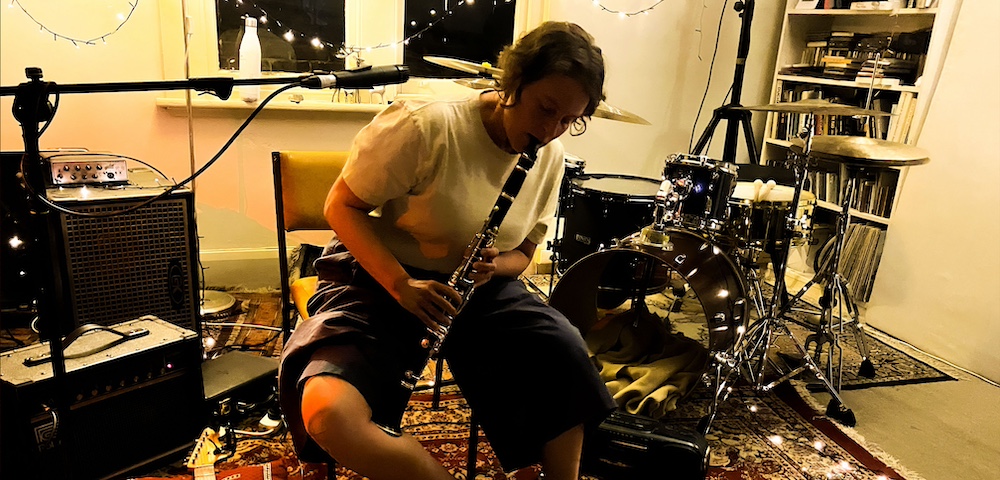
Image: Angus Sharpe
“I’ve created a fortress,” Laura Altman laughs on April 14 as she tiptoes barefoot over an electric guitar, around a clarinet, and through a smattering of radios, speakers, cans and trinkets. Finding her chair, she sits to face the small audience quietly waiting a foot away from her. Looking at the floor, she briefly considers her next step.
Fairy lights pulse as they run around her bizarre collection of items. They snake across the Persian rug, and up the walls of the tiny living room-like space of Stadium Rockdale. Outside, the sound of traffic can be faintly heard stealing into the room. Finally, Altman picks up a handheld cassette player. Holding it to her microphone, she switches it on and begins to perform.
Static enters the room. Distant waves. A far-off motorway. And carefully, Altman lowers this static to the strings of her electric guitar. Just before they touch, a short, sharp breath is exhaled from the strings. For a moment it seems quite possible the static has jumped to life.
Encouraged by this, and now absorbing herself deep in her tools, Altman begins to stretch the static apart. Switching on radios and portable speakers littered around her, then raising the soft mournful tone of her clarinet to various handheld cassette dictaphones, she begins to spin feedback into an instrument itself.
The music, if you close your eyes, is like where, after all lights are out, you lie in bed and turn your ears to the world. Silence, built from a chorus of tiny, almost imperceivable sounds. But with eyes open, it is impossible to not be transfixed by Altman’s rather chaotic movements. Blowing slowly through her clarinet, she holds the opening in various locations through her set-up to create different sounds. It may be held over an open can, with a dictaphone inside – her feet then covering the can to create swells of feedback. Or it might be pressed firmly against her calf, the muffled tones mixing with the dancing static around her. Like feeling in the dark, she moves objects around, placing items within or on top of each other to create different vibrations and sounds. Constantly she explores and experiments with the evolving electro-acoustic soundscape.
After the performance, Altman tells me her unique style came from a combination of two things. First, a desire to not have to rely on other performers to bring her music to life. Instead, when she first started playing solo eight years ago, she looked to build a quasi-band to support her clarinet out of devices and tools. Then, rather than using loopers and pedals like most solo performers would, she wanted her style to be distinct and free. So, over time she developed this abstract practice we were watching tonight.
Make no mistake, there was a challenging element to Altman’s music. The lack of patterns and rhythm made it difficult to sink into it as you would with a traditional genre such as rock or pop. But, as seen through Sydney with this type of experimental music becoming increasingly accepted by younger audiences, this challenge is one an audience meets with glee. Rather than immediately accepting that yes, this is an enjoyable sound, the audience is instead left to grapple with moments of pleasure and discomfort. Asking themselves, do I like this? And if so, why?
Though to conclude her set, Altman allowed a break from this debate. With the feedback still ringing around her – slowly swirling into silence like water down a drain – she lifted her guitar and struck a note. Deep, rich reverb rang out, and after a minute, another note followed.
With great care, in this manner, Altman built a folk song over the static – her soothing voice emerging finally into brief, beautiful lyrics.
The song gripped us. Drew us back to the room. And perfectly, finally, lowered us into applause.