
The Infinite Look: Rewriting The Night Sky Across Time And Place
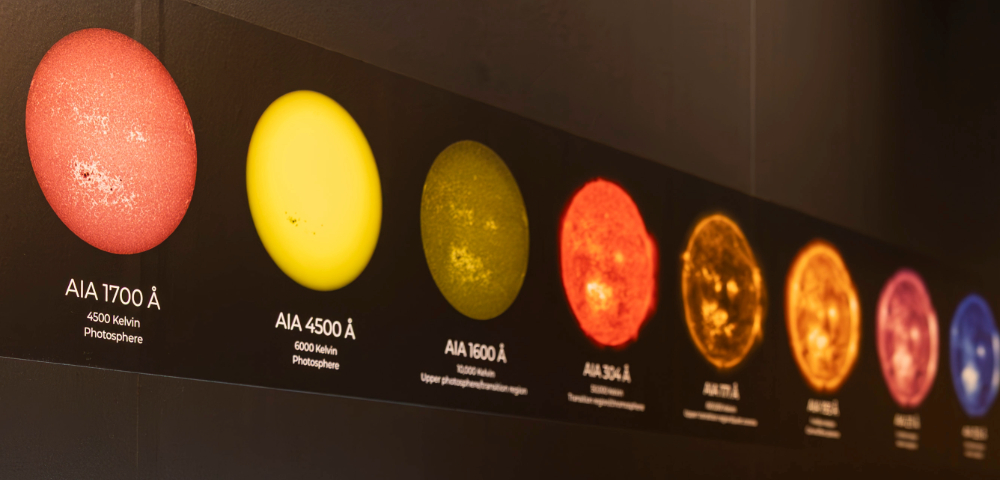
Image: 'The Infinite Look' exhibition at UNSW Library. Source: Supplied by UNSW Library.
A collision of astronomy, art and living cultural traditions, The Infinite Look pulls the night sky indoors at UNSW Library, tracing the link between humanity and the cosmos, from the faint marks of ancient stone observatories to the impossible clarity of the James Webb Space Telescope.
Developed alongside the School of Physics and School of Biological, Earth and Environmental Sciences, the free exhibition draws from the university’s courses and research, bringing together instruments, artworks, mineral samples, and archival materials from collections across campus.
Curator and art historian Dr. Megan R Fizell, who has been steering the project since 2024, says,
“It is such an expansive topic that we worked closely with subject-matter specialists to refine the displays and reflect the teaching priorities of the University.”
The result, spread across three distinct spaces, sits between a classroom, an arts archive and a science fair.
The first space explores the technology that opened up the galaxy, from early mapping instruments and hand-drawn lunar sketches through to VR experiences built around images captured by the Mars Rover.
The second considers our perception as those tools evolved, how different wavelengths reveal entirely different versions of the universe, while light pollution and space debris quietly chip away at the collective experience of stargazing.
And finally, ‘The Infinite Look’ turns to meaning, sitting with what the night sky has carried across cultures, as navigation, ceremony, myth, and a way of making sense of time and place.
“We all share the same night sky,” says Dr. Fizell, and the exhibition unfurls that idea through science and art, in a way that feels nothing short of intuitive.
Tiwi artist Timothy Cook’s Moon painting from the kulama ceremony sits near Pitjantjatjara artist Sylvia Kanytjupai Ken’s Seven Sisters work, both rooted in traditions marked the cycles of the sky long before the tools existed, offering different ways of holding the same expanse.
Anissa Jones, an Indigenous Academic Specialist at UNSW, presents digital works weaving imagery with the Dharug language, while UNSW alum Abdullah M.I. Syed responds to 19th century astronomy texts from the Library’s Special Collections with two portrayals of the Moon bringing identity, history and Islamic culture into the same frame.
Dr. Fizell says she was “particularly struck by how artistic traditions and scientific technologies developed in tandem,” and The Infinite Look makes that relationship easy to see rather than explain.
The timing aligns with the Artemis expedition dominating timelines, and Dr. Fizell cheerfully admits “I wish I could say that we coordinated with NASA.”
Still, the connection fits, with humanity’s history and relationship with space feeling like one unbroken thread across the exhibition.
The programming pushes the exhibition beyond the gallery with an inflatable planetarium hosting guided sessions with UNSW astronomers, while VR experiences let visitors take a brief spacewalk across Mars.
“While screens narrow our focus to a localised space directly in front of our face, outer space is the opposite. It is infinite and expansive,” says Dr. Fizell.
She hopes visitors leave “with a deeper understanding of how our relationship with the cosmos is a blend of both scientific advancement and cultural storytelling.”
A venture open to all, The Infinite Look is a journey through making sense of the night sky, especially for anyone who texts a friend to go look at the moon, or has ever looked up at a starry sky when the world feels too big.
The Infinite Look: A History of Gazing Skyward is running at UNSW Library till 30 October.