

‘No Other Choice’: A Scorching, Hilarious Satire About The Job Market
A pitch-black anticapitalist satire about one man’s erosion of his own class solidarity, Park Chan-wook’s No Other Choice is another fantastic entry into the South Korean director’s sensational filmography. It’s a gorgeously made and genuinely hysterical film, made all the better in its willingness to have commentary with a genuine edge to it laced into its foundation.
It’s not hard to empathise with the plight of No Other Choice’s Yoo Man-su (Lee Byung-hun), a man laid off from his position as paper mill manager after 25 years. Unable to find work for over a year, he and his wife Lee Mi-ri (Son Ye-jin) are forced to sell their house to keep their family afloat.
Then, while he’s looking for jobs one day, Man-su has an idea… What if he were to quite literally eliminate the competition who’d apply for the same paper mill roles as him? Through his repeated mantra of “no other choice”, Man-su hatches an elaborate scheme to guarantee himself a job, even if he has to kill for it.
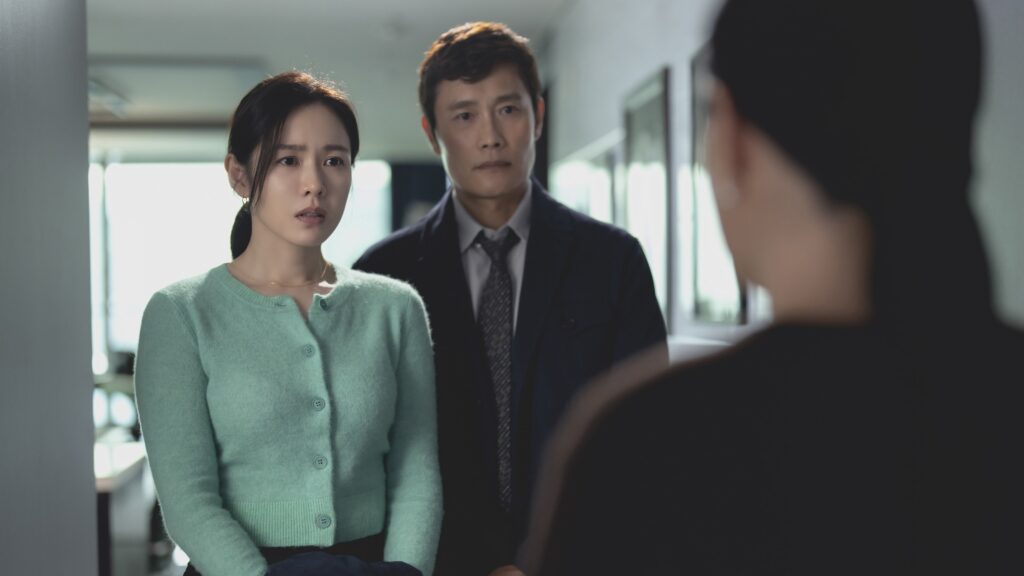
How far would you go to get a job?
It seems that the comparisons to Bong Joon-ho’s Parasite are inevitable with No Other Choice. Though there are a lot of parallels, what sets this film apart from the Best Picture winner is its more satirical edge that it uses to provide scorching criticism of what a job market ultimately beyond our control forces us to do.
Lee Byung-hun delivers one of his best performances as Yoo Man-su in this film, working in perfect synchronisation with a razor-sharp script to initially portray him as a principled manager before slowly unveiling him as a strange, fairly awful man long before he was driven to kill in the name of employment.
Despite his lamentable qualities, Byung-hun’s ability to make him a bottomless well of cowardly resolve means that the character is nothing short of delightful to follow across the runtime of No Other Choice. Such fascinating characterisation of Man-su culminates in a number of scenes throughout the film, most notably his first encounter with a competitor and his wife.
The scene maintains tension while embracing genuine slapstick comedy in a truly entertaining sequence – but it’s also the first time that we see that Man-su doesn’t really have ‘ideas’ or ‘morals’ in the traditional sense, instead revealing himself as a blatant opportunist that inevitably lands on the insane goal of killing his competitors. Even so, is that completely his fault when the system is what’s led him to such a conclusion in the first place?
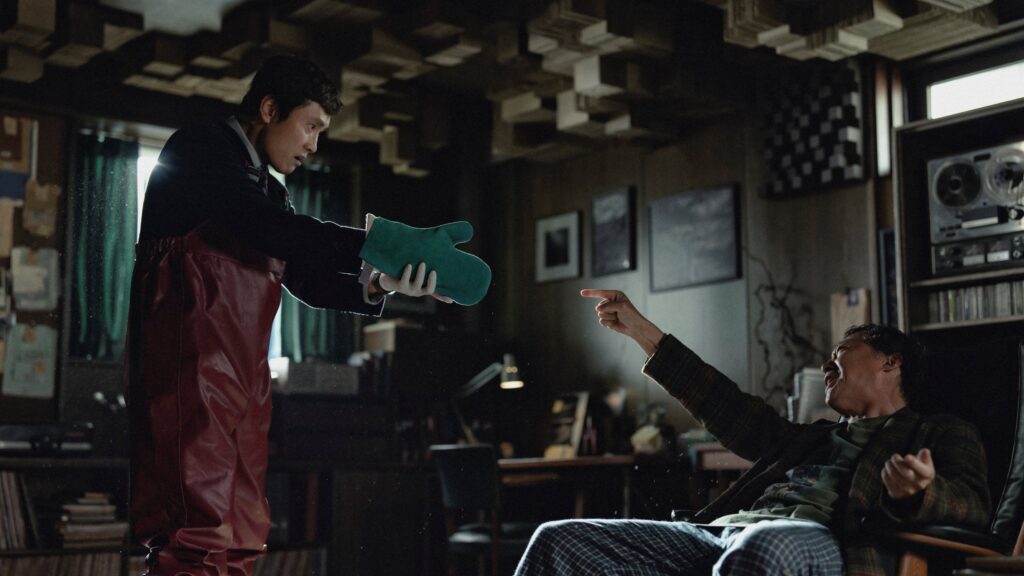
The visual splendour of No Other Choice
Like with all of Park’s other films, No Other Choice is also a fantastic display of filmmaking prowess. With almost supernatural ability, Park is able to oscillate between slapstick sequences and genuinely horrific imagery, all while doing so with an unbelievable eye for detail. Part of this is also owed to the supporting cast, including a particularly sensational Son Ye-jin, who Park directs with real panache.
In particular, Kim Woo-hyung’s cinematography breathes a staggering amount of life into the movie, with multiple shots and sequences seemingly inventing new cinematic languages. The way that Park utilises modern technology in his films continues to astound, with a late-film sequence with a tablet somehow being one of the most visually impressive shots of the year.
Yet through all of its hilarious setpieces and visual splendour, No Other Choice ultimately excels thanks to its decidedly pointed commentary. Park’s film is a fascinating exploration of how the job market not only dehumanises the worker, but causes us to dehumanise each other, inevitably leading to isolation and forgotten solidarity with your fellow workers – and manages to do so while being one of the most fun movies of the year.
★★★★½
No Other Choice is in cinemas from January 15th.