
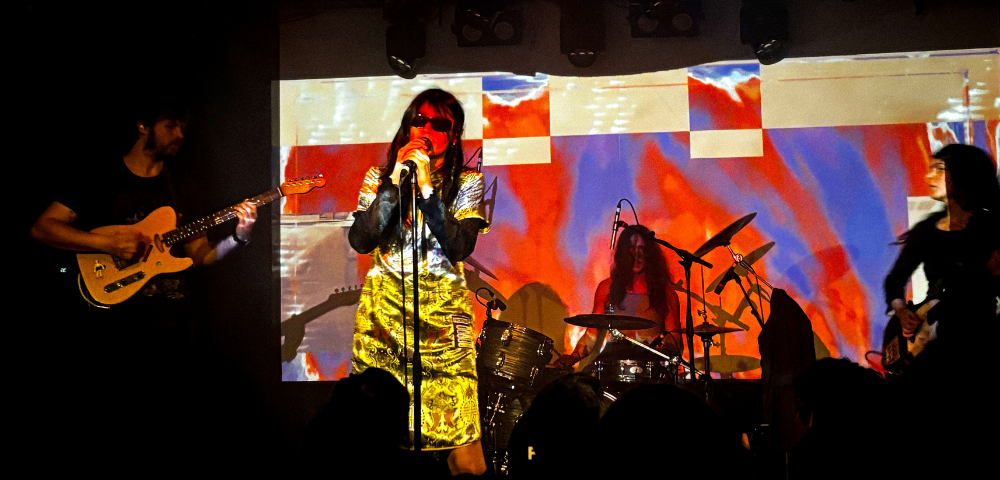
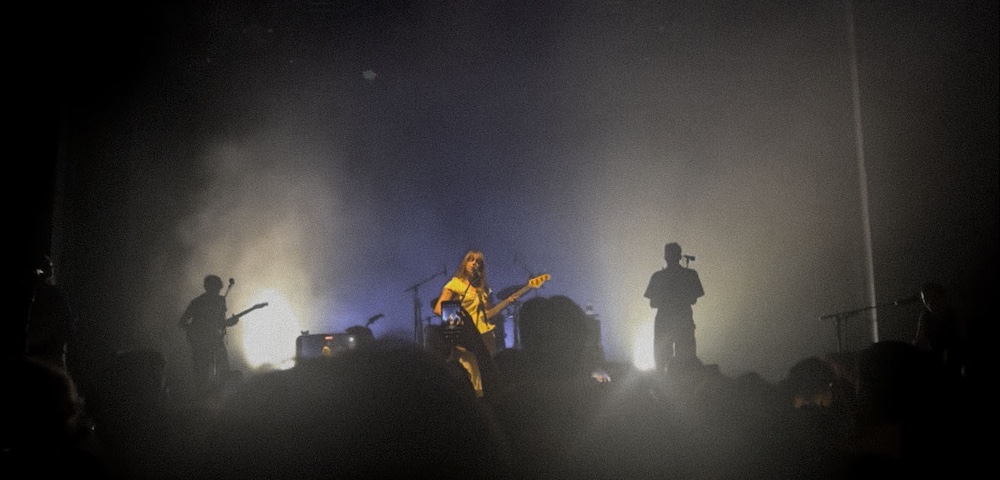
Image: Water From Your Eyes. Credit Angus Sharpe
It is Wednesday, March 11, and the Oxford Art Factory has been ripped into a wormhole. Before a stage bathed in swirling patterns, the audience braces for a new reality.
New York pop-rock project Water From Your Eyes greet the room with what sounds like Doctor Who’s Tardis squashed and torn apart in a blender. The project – traditionally a duo made of Nate Amos and Rachel Brown – tonight enter as a four-piece. While their recorded music is heavily reliant on layered samples and driving drum machine, throughout the coming performance guitarist/bassist Al Nardo and drummer Bailey Wollowitz will help reimagine it as fast, loud rock n’ roll.
Brown glows as she takes centre stage, her bandmates readying themselves in the shadows. Sunglasses disappear into her braided black hair. Colours curl over her patterned silk dress. She leans into her microphone, staring directly into the swirling projected light.
“What’s up Sydney…” her dry, sarcastic voice winds through thick reverb. Then, with a question she will return to later, “Who knows what the future holds? I hope good things.”
The warped noise stops. Amos – whose name is rapidly becoming synonymous with a new wave of electro-pop coming out of New York – fires into the strings of his guitar. With drums and distortion rocketing behind him, and a backing track imperceptibly weaving through the mix, he delivers the searing opening riff of fan favourite, Life Signs. As the riff transitions into a chugging staircase of chords, Brown folds deep into her microphone and begins to deliver flat, rhythmic lyrics.
Over the next hour, Water From Your Eyes deliver an array of music from 2023’s Everyone’s Crushed, and 2025’s It’s a Beautiful Place.
While heavy drums seamlessly morph with a rapid drum machine, Nardo and Amos play their instruments as if taming animals in their arms.
Nardo – switching between bass and guitar – rides her instrument as if a wild horse. It swings back and forth, trying to escape her grip. Yet clinging to its neck, she manages to convince deep, resonant bass or charged distorted chords to grind into the cantering music. Opposite, Amos’ guitar is a well-trained hound. With a deft touch, he commands it to growl, bark and cry. Sliced riffs are often more percussive than melodic. Yet when he does let his strings run free, they corkscrew into the room in fast, distorted inflections.
In an interview with Alternative Press, Brown says that she writes her lyrics to the rhythm and melody Amos has already devised. As if piecing a puzzle together, she will throw out words which condense her political ideas into syllables needed for the song’s rhythm to work. Such structure is clear in her delivery tonight. With a monotone voice which occasionally develops into a heavily reverbed melody, her bar-like lyrics complement the rhythm of Amos’ barking guitar, filling gaps between his inflections.
Then, between songs, her mystique drops. On a bed of rising noise, she clumsily delivers endearing stream of consciousness monologues about mundane topics like getting sunburnt, going to the zoo, or what her bedtime prayers consisted of as a child. Each monologue – performed before every song – produces laughter and cheers from the audience. Humanising elements within the otherwise abstract whirlwind set.
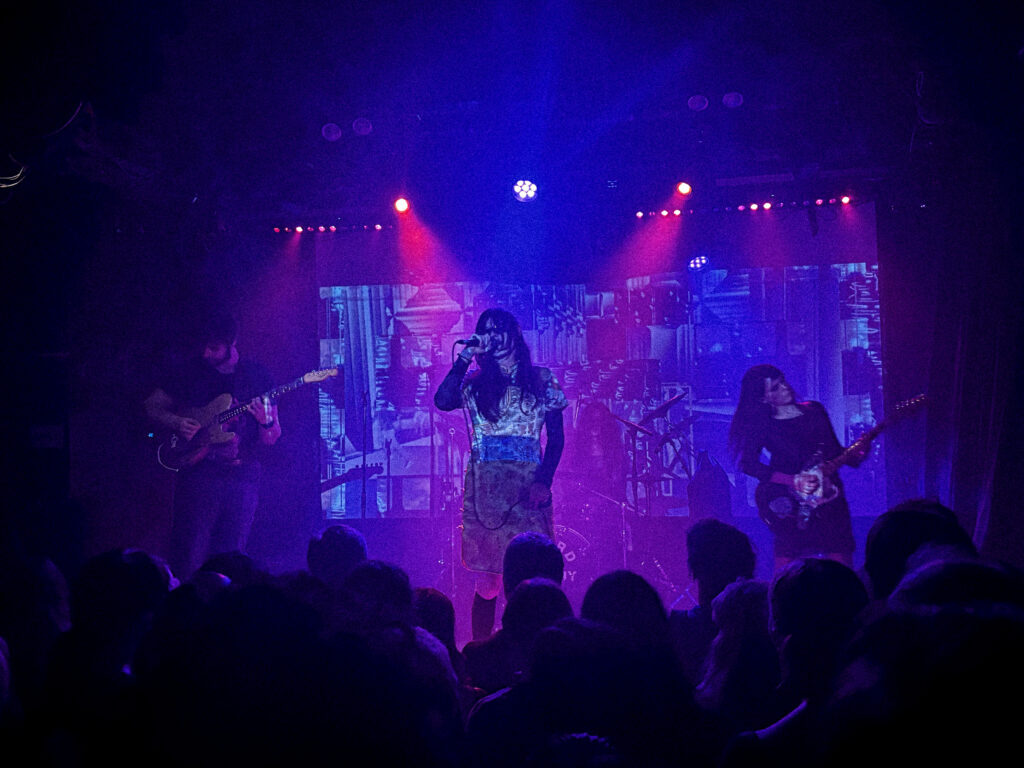
Toward the end of the performance, one such monologue takes a serious tone. In a rousing speech which reflects the common theme of her lyrics, Brown speaks of the future she alluded to at the beginning.
“Every day I wake up to the news and my heart breaks,” she begins, “I’m tired, and sick, and angry. And I do not believe in the US empire. I do not believe in funding death. I do not believe that in the last two years people have been dying in Gaza in vain. I do believe there is a free Palestine in our future. I believe fascism will fall. I believe in land back for indigenous people across the globe. I believe that once this is all achieved there will be peace in our world, and that’s all I want. So free Palestine and fuck the US.”
Between every sentence, the audience erupts in cheers and applause. While highlighting the flaws of the modern world, there is an optimism in Brown’s words. An optimism which could be seen not only in this monologue but in her tongue-in-cheek lyrics, and the fun, free music which supported them.
It is refreshing and inspiring to see such new, experimental music mix with sobering perspectives of the modern day.
At the conclusion, as the wormhole closes, the audience is finally delivered to their new reality. It appears much the same as the one we existed in before the performance began, but this reality now holds perhaps a tiny glimpse more of hope.


Leave a Reply