Black Country New Road Continue Their Bold Evolution at Enmore Theatre
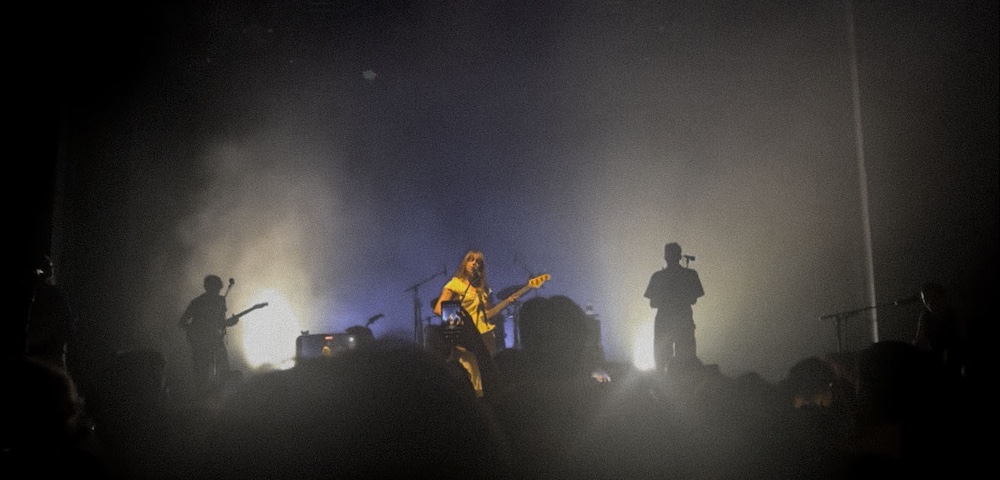
Image: Angus Sharpe
“One of the best shows we ever played was at a cricket club where 100 people were waiting outside for us to stop playing.”
Charlie Wayne, percussionist of the critically adored English six-piece Black Country, New Road (BCNR), laughs as he tells me this between sips of beer. We’re sitting in the sun no more than 100 metres away from the Enmore Theatre on Tuesday, February 24. Just out of sight is a queue of BCNR fans, all eagerly waiting to be allowed inside the famous venue.
“We were so bizarrely self-confident,” Wayne continues, still laughing. “We grew up playing shows in Cambridge where the aim of the game was to make music so specific that if there were fewer people in the audience when we finished playing, that was a big success… I think we always knew that our music had a place somewhere though…”
This is a belief BCNR have remained loyal to throughout their career.
Over four acclaimed albums and a dramatic change to their sound, the band have never seemed concerned about the approval of an audience. Instead, with each new batch of music, they have moved into new territory, trusting that their sound will always find a home.
Comparing their 2019 debut single Sunglasses to the music they performed at the Enmore Theatre on Tuesday night, it is hard to believe the same band is behind both. On one hand, Sunglasses is a slow descent into dissonance. A furious beat drives beneath distorted guitar. An ever-present saxophone howls first into a climax before bare-knuckled beating the rest of the song into a chaotic pulp. Meanwhile the lyrics, performed by Isaac Wood – who left the band in 2022 – surge with an increasingly desperate, panicked anger.
Yet tonight, as the band emerged onto the Enmore Theatre stage and the roar of over 2000 fans dimmed, what rose from the six members held none of this menace. Instead, with her bandmates silhouetted behind her, Georgia Ellery – one of three lead vocalists – began with the slow pluck of a mandolin. A gentle hum from fellow vocalists Tyler Hyde and May Kershaw joined, allowing Ellery’s soft voice a ledge to leap from. And here, Ellery spun Two Horses into the silent theatre – a folktale of a traveller who naively falls in love with a man destined to betray her.
Like many BCNR songs, Two Horses twists at its peak. For its first half, it is sparse, and beautiful. Saxophone waltzes quietly behind Ellery’s mandolin. Chorused whistles blow in like playful birds. And harmonies build toward a serene climax. Here, with a dramatic change of pace, a bass riff begins to swagger. Drums – like horses let free – begin to canter. And the rest of the band joins in a race to the fast, wild conclusion. Within this swelling euphoria of piano, guitar, mandolin, drums, saxophone, and bass, Ellery, Hyde, and Kershaw all project their voices together in one final Hollywood-western-style harmony.
Capturing the gentle beauty of many of the songs to come, as well as the cacophony most will build to, it was a perfect piece to open the band’s hour-and-a-half set.
With each member changing instruments at least once – even Wayne at one point replacing his drumsticks with a banjo – BCNR played through their entire 2025 baroque-folk album, Forever Howlong. And in a testament to how tightly in tune the band are, the performances of these intricately arranged pieces were remarkably faithful to the recordings.
Speaking on this, Wayne explained how – as the band have evolved and their music has become more involved – they have had to grapple more with how rigid a performance can be. Where in the past they have had the freedom to write songs on stage through live improvisation, today – especially with this new album – they have had to be more precise with their performances. This means deciding on certain iterations of pieces and committing to them completely. Yet with that said, Wayne also stressed how important it is for a song to remain alive and malleable enough to always remain somewhat creatively satisfying.
An example of this was when Hyde took a seat at the piano and performed a slow, operatic rendition of Dancers – the only song from their previous catalogue the project performed all night.
Despite the night’s brilliance, the standout moment came toward the end.
Here, preparing to perform the title track from the album Forever Howlong, every member other than Kershaw drew a baritone recorder from a hessian bag and held it to their lips.
Laughter flittered through the audience, but soon – as Kershaw raised her hands to conduct her bandmates – all thoughts of humour were abolished by awe.
With each member playing in different registers, the harmonies the recorders made as they swelled beneath Kershaw’s voice were so alien and so complete they seemed to exist beyond the band and float liminal around them.
They fired with each movement of Kershaw’s wild arms. They descended to the floor before flying again to the ceiling.
They were bizarre, and experimental, while strangely familiar, and thoroughly traditional. It was a sound I had never heard before, and a reflection of not only masterful songwriting and musicianship, but the band’s fearlessness to explore new terrain.
Most importantly though, it was a sound I am certain would make anyone in a Cambridge cricket club leave the room with haste.