Two Sydney Exhibitions Honour The Queer, Asian-Australian Legacy Of Andrew Hau Ewing
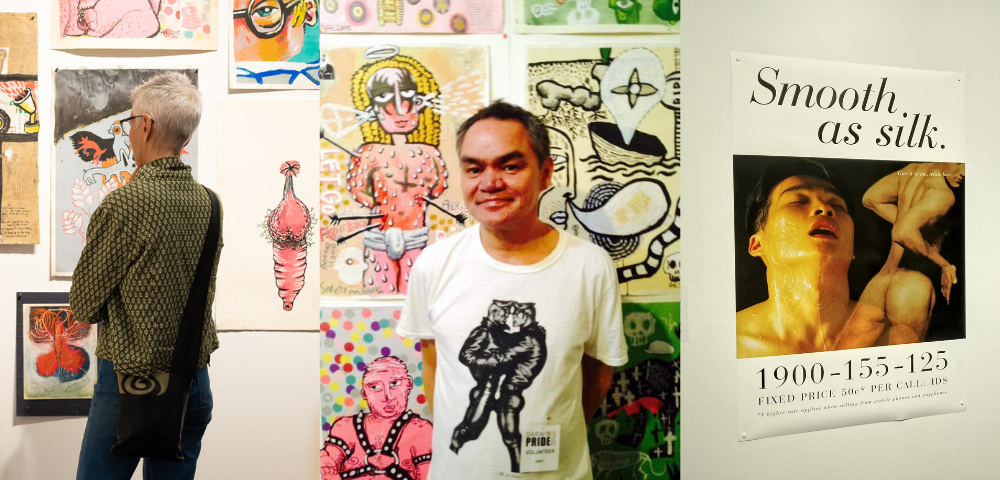
Image: All photos: Supplied
There was an air of celebration at the recent opening of two related queer exhibitions at 4A Centre for Contemporary Asian Art in Haymarket.
Ancestor Spirits was the first major retrospective of the late Andrew Hau Ewing (1964-2021), an artist whose practice spanned Sydney, Byron Bay, Indonesia, Cairns, Darwin and Adelaide.
He also worked as an illustrator for Star Observer and other gay publications during the 1990s.
The exhibition was also tied to 4A’s Andrew Ewing Fellowship, awarded to an emerging queer Asian-Australian artist and culminating with the exhibition In the Half Light by Kirthana Selvaraj.
4A is a small but significant player in the Australian contemporary art scene. It was set up in the mid-1990s as a platform for resistance and unity in the wake of anti-Asian sentiment fuelled by so-called ‘Hansonism’.
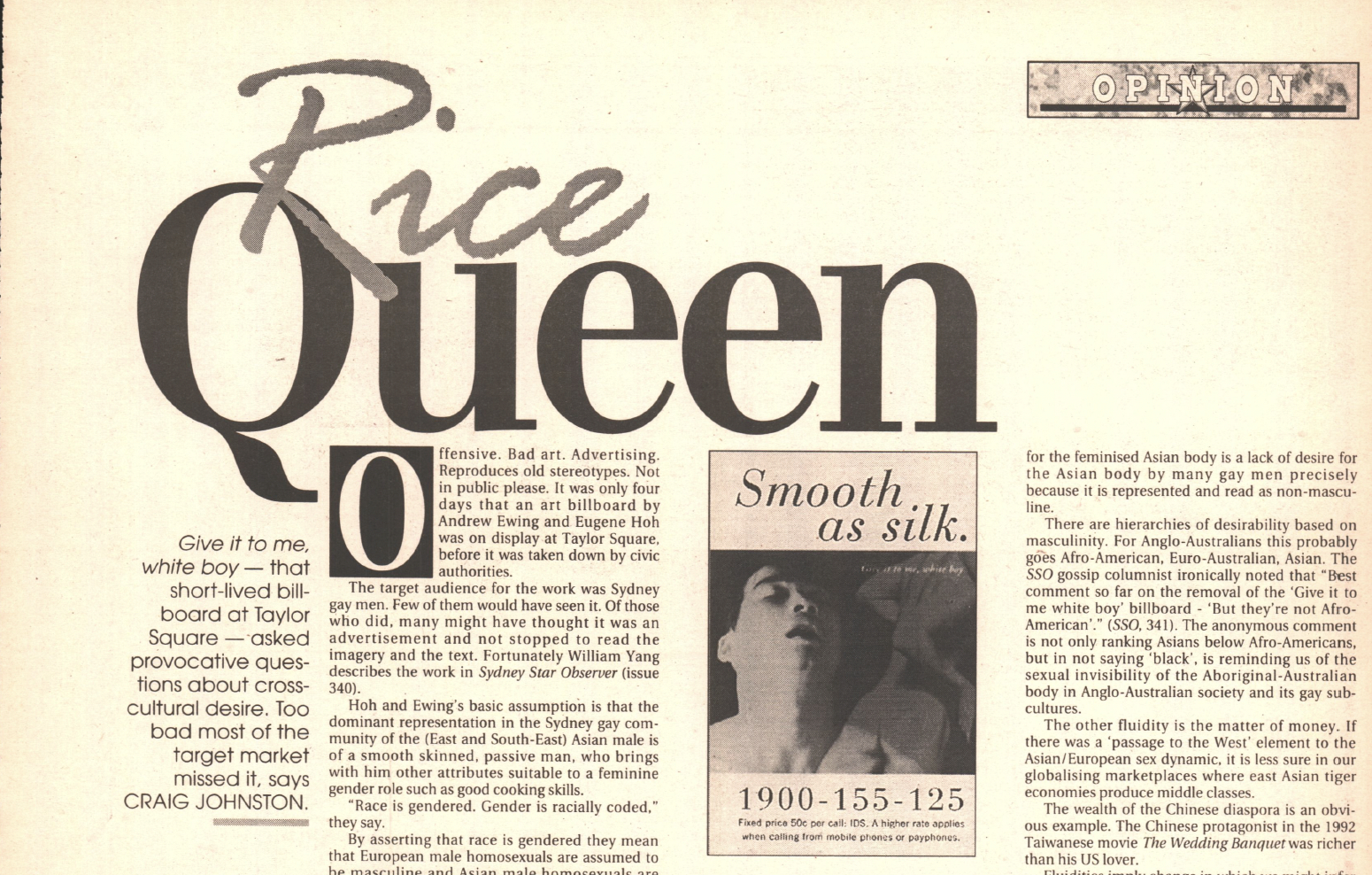
Similarly, Ewing’s practice was forged in the 1990s and challenged stereotypes of gay Asian men. The exhibition includes a scaled-down copy of Reinscribing Skin, the controversial billboard he created with Eugene Hoh for the 1997 Sydney Mardi Gras Festival. It shows an erotic image of Asian men in the form of an escort ad – but the 1900 number on the advert instead directed the caller to various pointed questions about their presumed stereotypes.
The billboard in Taylor Square was famously taken down after two days because of various complaints, triggering a barrage of commentary in the gay press and ensuring longevity for its loaded line “Give it to me, whiteboy”.
The exhibition’s wall text rightly picks up on the radical Asian-Australian perspective advanced by this work. The exhibition is spot-on in other aspects. It manages to show the various depths and dimensions of Ewing’s practice while being concise in its display. Queerness was one aspect of Ewing’s work as was being Vietnamese-Australian, the son of a white Australian father and Vietnamese mother. Some works confront this bicultural struggle head-on as with the work with text (in capitals): “MUM FUCKED DAD & I FUCKED MYSELF UP GOOD”.
Ewing’s family, particularly his sisters Margy and Therese, are also present in the exhibition through their display of a Buddhist shrine for Andy, and in recreating his final work desk in Adelaide – a space for inspirational books, images and mottos, visual diaries and artworks including his small-scale sculptures.
As the inaugural fellowship recipient, Selvaraj was commissioned by 4A to create new work in response to Ewing’s work, the bulk of which she accessed through the Australian Queer Archives which holds a significant volume of work donated by his family. Like Ewing, Selvaraj works mainly in 2D yet, refreshingly, their styles are quite different. Ewing’s work is occasionally lyrical though mostly graphically charged.
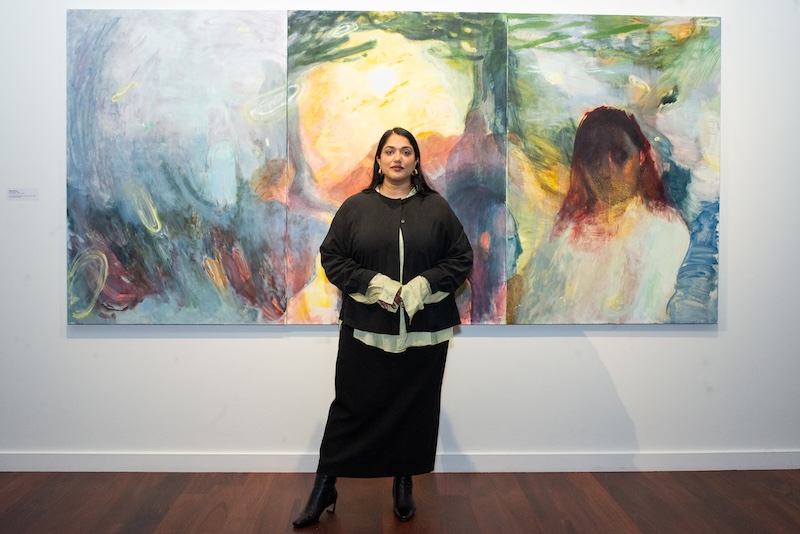
Selvaraj’s work, as evident in In the Half Light, is mostly lyrical and atmospheric and absorbed in the process and materiality of paint. She finds most connection with Ewing’s sense of ‘unresolved’ memory and with his challenges with illness (pancreatitis and diabetes) in view of her recent diagnosis of multiple sclerosis.
Ancestor spirits comes from the title of Ewing’s short poem written after his first visit to Vietnam in 1997. It’s a poem about honouring one’s heritage and being at peace with one’s self. The realisation of this exhibition atones with this sentiment.
Both exhibitions commemorate queerness as complexity: personal, political and embodied.
Curated by Con Gerakaris, both exhibitions are on at 4A, from 10 October to 13 December 2026.
Maurice O’Riordan is author of ‘candid enigma, the artful adventures of Andrew Hau Ewing’ (dishevel books, 2025).
Leave a Reply