

‘The Wizard Of The Kremlin’ Refuses To Leap Off The Page
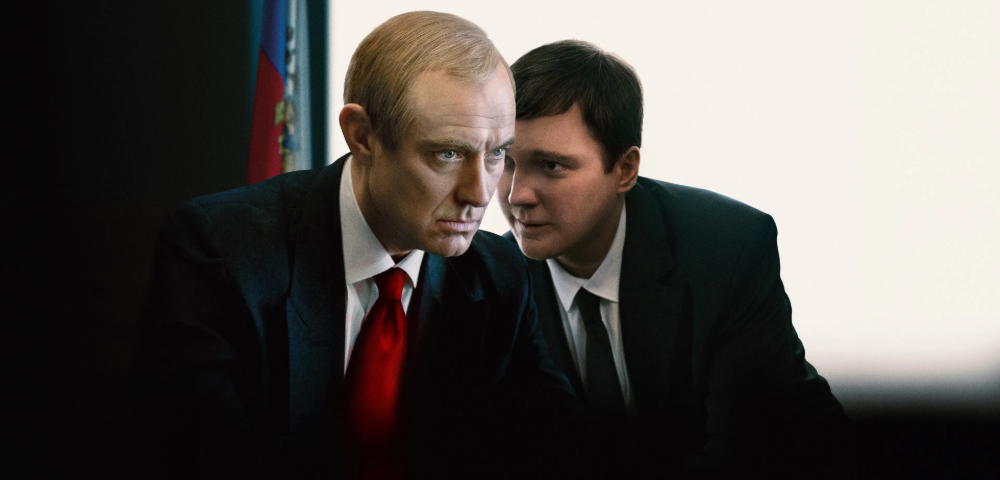
Image: Poster for 'The Wizard Of The Kremlin'. Source: TMDB.
Rich and urgent yet inert, The Wizard of the Kremlin explores the making of modern Russia and the spin doctor who propped it up, only to find itself trapped between fascinating ideas and lifeless execution.
Directed by Olivier Assayas and adapted from Guiliano da Empoli’s novel, The Wizard of the Kremlin traces Russia’s post-Soviet transformation through Vladimir Baranov (Paul Dano), a fictional government strategist who helps manufacture the imposing myth of Vladimir Putin (Jude Law) and the Federation.
Painfully relevant in an era of rampant misinformation, it’s undeniable in its potential. The material is rich with enthralling themes of power, corruption, and propaganda, not to mention its stacked cast.
Yet somehow, against all odds, it’s a gruelling watch.
The film straddles political thriller, historical drama and satire, and still never quite settles into a rhythm. Its cynicism suggests satire, its scope suggests epic drama, yet its execution remains restrained.
The story unfolds in flashbacks, framed by a 2019 interview between Jeffrey Wright‘s probing journalist and Baranov, the disgraced Kremlin strategist recounting his journey from idealistic creative to barely reluctant architect of a new Russian reality.
Those early chapters of Baranov’s recount are genuinely alive. Post-Soviet Russia in the 1990s crackles with chaotic artistic energy, the visuals warm and loose and drunk on possibility, before slowly draining into something colder and more sterile as Vadim’s idealism gets quietly eaten alive by the machine he’s building.
For a stretch you can see the film it desperately wants to be, sharper and more compelling, but then it just keeps going.
For anyone keen on the Russian grandpa’s lore alone, for whatever reason, he remains a more passing force than the central figure here.
The Wizard of the Kremlin is far more interested in the machinery that built the myth than the man himself, an intriguing angle that it observes rather than interrogates.
Despite his limited screentime, Law’s Putin, leaves the strongest impression. Controlled and imposing, he magnetically embodies Putin’s carefully cultivated machismo, capturing the cold confidence of a man who believes they were born for power.
There’s no denying the screenplay has its moments. Some exchanges crackle with sharp insight into censorship, how easily artistic ambition can curdle, how propaganda doesn’t thrive through force alone and more.
The ideas are undoubtedly there but the compelling drama, less so.
Faithful to its source to the point of self-sabotage, it often feels more like history being recited rather than experienced. Major political turning points from the death of the oligarchs and the Orange Revolution to the rise of bots, rush by with barely a breath, while conversations with little to no momentum linger.
A non-existent score, choppy editing and resolutely functional direction drain tension from moments that should feel like something, anything.
Following his descent from idealist to propagandist, Dano delivers another intelligent, quietly measured performance, but he’s boxed in by writing that mistakes emotional distance for complexity.
Alicia Vikander as Xania, Baranov’s aloof love interest, brings welcome warmth, grounding Vadim with the closest thing the film has to an emotional pulse.
However the most distracting cherry on top, and only creative choice, is an inconsistent approach to accents, with characters drifting between vaguely Russian inflections and none at all.
More frustrating, though, is how passive and soft the film is on the people it’s depicting. The moral reckoning here feels oddly muted for a story soaked in poison, and The Wizard of the Kremlin too often settles for plainly narrating history instead of engaging with it.
While political junkies and history obsessives will find plenty to chew on, for those seeking a genuinely gripping political character study, Alli Abbasi‘s ‘The Apprentice’ remains the modern standard.
Ultimately, for a story about the power of narrative to shape a nation, The Wizard of the Kremlin never quite discovers the power of cinema to shape a story.
2/5
The Wizard of the Kremlin releases in cinemas on 23 July.









Leave a Reply