
Police Violence At Sydney Herzog Protest Took Us Right Back To That Riot, Say 78ers
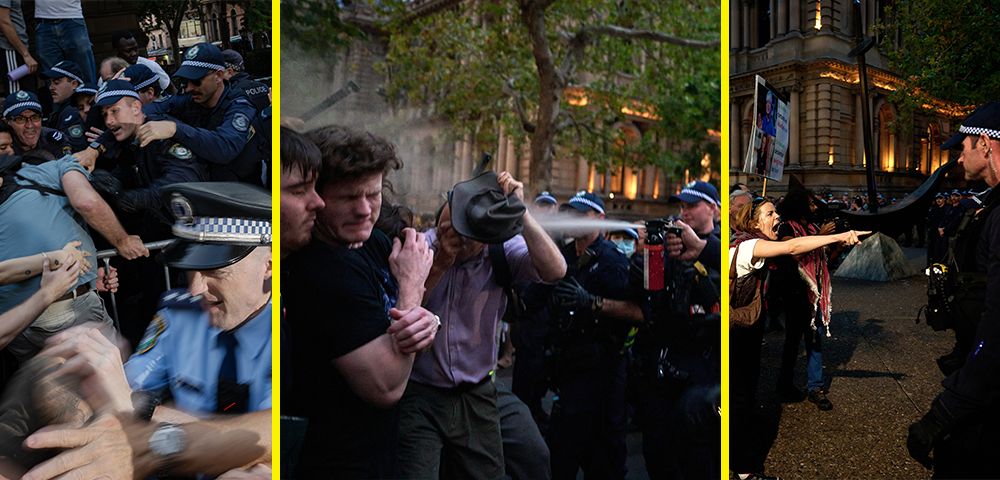
Image: Flavio Brancaleone / AAP
For some of the original 78ers, the police operation at last week’s protest against Israeli President Isaac Herzog did not feel like a contemporary moment. It felt like 1978 all over again.
Mounted officers surged and pepper spray was heavily deployed at Sydney Town Hall on February 9, with police allegedly punching protesters and forcefully dragging Muslim men as they knelt in prayer.
27 people were arrested and dozens injured.
Within days, several 78ers publicly said the scenes had triggered traumatic memories of the first Mardi Gras, when LGBTQ+ people were attacked by police, and 53 people were arrested and many assaulted in cells at Darlinghurst Police Station.
“I found myself reliving 24 June 1978 — the horrors, violence, and trauma inflicted by police on the 78ers that night,” Peter de Waal, founding member of CAMP, said, describing the “painful clarity” of those memories returning.
Mark Gillespie, Graham Chuck, Steve Warren, Meredith Knight and Peter Murphy joined de Waal in calling for an independent investigation, condemning what they described as political repression of protest movements.
Their pleas came just before the Law Enforcement Conduct Commission (LECC) announced it would investigate, following a significant number of complaints.
NSW Police Commissioner Mal Lanyon has denied all allegations of police violence, while apologising “for any offence that may have been taken” after Muslim leaders said the violent disruption of prayers breached religious sanctity.
Premier Chris Minns has refused to apologise to the Muslim community, and defended police. He claims, much to the indignation of many attendees of the protest, that officers did “everything possible” to avoid confrontation after protesters defied restrictions on protest, which were introduced in the wake of the tragic Bondi Junction terror attack.
Anti-protest laws face growing scrutiny in NSW
The confrontation has reignited broader concerns about NSW’s protest laws. While the temporary protest restrictions have now lapsed, civil liberties advocates argue the state’s slow but clear erosion of protest protections has created a climate where heavy-handed policing is more likely.
First Nations activists are now mounting a constitutional challenge, arguing it impermissibly burdens the implied freedom of political communication.
“Aboriginal people were also on the front lines in support of our Palestinian brothers and sisters,” said Dhungutti activist Paul Silva. “The attack against us was completely unprovoked… But we will not be intimidated and will continue to campaign in the courts and on the streets to remove all restrictions on our rights to demonstrate and speak freely.”
Their case adds to a growing chorus warning that the right to peaceful assembly in NSW has been steadily narrowed.
For the 78ers, the debate is not abstract. From the 1978 Mardi Gras arrests to the policing of the 2004 Redfern protests following the death of TJ Hickey, and confrontations at Invasion Day rallies, it’s hard not to acknowledge that NSW has a long, long history of fraught encounters between police and protest movements.
Greens justice spokesperson Sue Higginson welcomed the LECC inquiry as an important step towards transparency.
“This is what the community needs, and it’s what the Police need too,” said Higginson. “It is in no one’s interest to have police acting with impunity – it leads to violence”.
Nearly half a decade after the first Mardi Gras, the 78ers say the lesson remains the same: protest is a democratic right — and when that right is met with force, history has a way of resurfacing.





Leave a Reply