Cameron Winter Embraces The Light at The Sydney Opera House
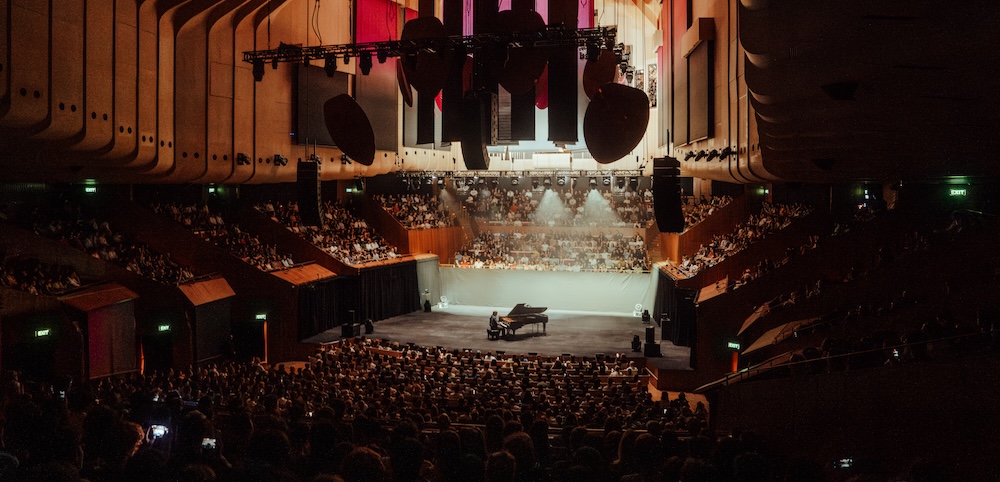
Image: Ravyna Jassani via SOH
Within a theatre, an audience is at the mercy of its architecture. How the ceiling slopes. How the walls rise. How the stage expands before them. And equally – as was so remarkable throughout the performance of Cameron Winter in the Sydney Opera House Concert Hall on February 16 – architecture is at the mercy of light.
The night began with a rainbow. Arcing across the blackened sky, the spectrum of colours fell behind the Opera House sails as if penetrating the building itself. In the background, the Harbour Bridge glowed golden. And in light rain, many from the sold-out audience stopped in awe of the image. A premonition of the evening to come.
Much of the first half of Winter’s performance was spent with him in the dark. Dressed in a hoodie and cargo pants, the 23-year-old Brooklyn singer-songwriter – famous for both his solo work and as frontman of the meteoric art-rock four piece Geese – seemed disinterested in making a spectacle of himself. Instead, with his back to us, he bent over his Steinway as light poured into the sculptural body of the building above.
Framed by hanging red panels, and backed by a curved wooden ceiling, the room’s organ became the focus of our attention. Church-like it glowed as the dark musician rocked into his keys below.
He played with the heavy clumsiness one could only manage if classically trained. Battling the instrument, he would push down upon his keys, as if preventing them from flying away. Chords waved like flames, and on occasion, with light fingers he would allow the piano to breathe – sparks of notes tinkling into the dark.
Atop this music, Winter placed his authentic, unconventional voice. Like heat, his lyrics thrummed through the body of the theatre. Rapid abstract prose pressed against the ceiling before cooling into long, emotional laments which rained down upon us.
Drawing from his critically adored debut solo album Heavy Metal, with the addition of three unreleased songs, and one beautiful closing single Take it With You, Winter’s lyrics were laced with abstraction.
“I feel like there is nothing worse than going into a song like, ‘I’ve got something to say…’” the songwriter told journalist Zane Lowe when asked about his abstract writing in an interview on Apple Music. “… You’d end up writing a song that’s all about some super specific issue… The clearer the message the less powerful it can come across.”
This is exactly what we experienced throughout his performance. Despite the ambiguity of meaning, Winter’s ballads contained powerful perspectives on spirituality, ageing, creativity and love. Lyrics would rise to the surface through blizzards of abstraction, containing such stark self-awareness, and presented with such deep emotion they made it impossible to move.
It was during such a moment in Drinking Age that the lighting changed.
The piano was slow and rising. Atop it, Winter warbled the single word, “Today…” He drew it out, his tone rising with the piano, before continuing the lyrics with as much emphasis on each following word, “… I met who I’m gonna be from now on / and he’s a piece of shit.”
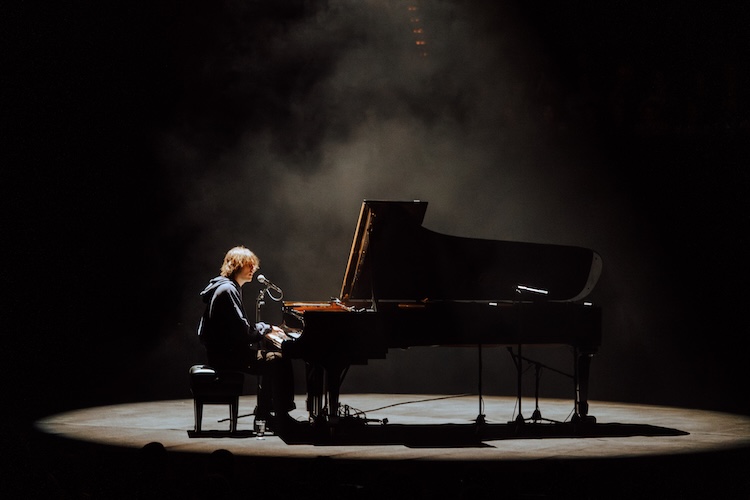
The piano paused. One sharp note rang out. And light exploded from behind him.
The theatre gasped. Winter froze over his keys, allowing his lyrics to linger. Shards of light beamed through the smoke now hanging around his figure. The stage and everything around it disappeared. And in its place stood a perfect silhouette within a burning star.
From that point forward, light played a crucial role in emphasising momentous points in songs. The one other exceptional moment being when during fan-favourite $0, Winter desperately wailed the frantic, tongue in cheek lyrics,
God is real, God is real
I’m not kidding, God is actually real
I’m not kidding this time
I think God is actually for real
God is real, God is actually real
God is real, I wouldn’t joke about this
I’m not kidding this time
Meanwhile, the house lights rose. Slowly we were illuminated and welcomed to heaven.
Encouraged by this, shouts of excitement began to erupt through the audience, culminating in a loud cacophony of cheers.
Yet none of these lights were what I left the performance thinking of.
This only came when, having finished his encore, Winter rose from his stool and looked out at us. We had already erupted into a standing ovation, and it was the only real moment he had addressed the audience the entire night.
He gave a small, shy smile. In that smile, he became not the virtuosic songwriter he is being lauded as around the world, but the shy 23-year-old boy who had just played a sold-out performance at the Sydney Opera House.
Youth, pride, and awe at the sight before him glowed in one final light.