

Guardian Angels, Vigilantes, And Neighbourhood Watch (Naked City)

Image: via Reddit
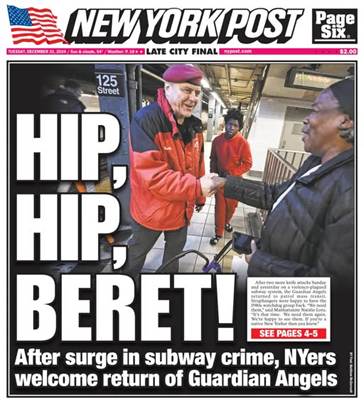
When visiting New York City in the early 80s and riding the graffiti plagued subway, I was intrigued to see a group of uniformed young men and women, all clad in red berets, patrolling the at times menacing carriages. They were the Guardian Angels of course, and their presence then was relatively reassuring. The group was formed in 1979 by Curtis Sliwa and went on to achieve world wide recognition with lashings of media attention paralleled by a franchise of operations around the globe – including a brief stint in Australia!
Over the years I have read various news items about the Angels and viewed a number of documentaries. I even got to speak briefly with Sliwa at a media bash when he visited Australia in 1992, hoping to establish a local chapter. Apart from one of those Facebook posts a few years ago, highlighting that his New York apartment was now home to seventeen stray cats, I had almost forgotten about him.
Yet a few days ago there he was on the TV coverage of the New York mayoral election, still sporting a red beret in his early 70s, and standing as the Republican nominee for mayor. It was his second crack at the office and prior to Zohran Mamdani’s overwhelming victory he was polling a rather paltry 15 per cent of the vote.
Guardian style groups are rare in Australia and often short-lived. Chapters of the US Guardian Angels established in Melbourne and Queensland appear to have had little impact or any real longevity. Around a decade ago a vigilante group known as the Soldiers Of Odin began patrolling various areas of Melbourne’s CBD and neighbouring train stations. They claimed they were doing so to protect the public from what was seen as an increase in street crime and threats from various gangs. They were essentially a chapter of the far right anti immigrant Finish group of the same name, copying their black uniform jackets and t-shirts, and sporting both a Norse war helmet and Australian flag. Mercifully they appear to be no longer operating.
It’s understood that many parts of Australia are experiencing high levels of what is often described as ‘suburban crime’ – break ins, muggings, car theft and the more recent phenomenon of home invasions. The unwanted guernsey of Australia’s crime capital currently belongs to Alice Springs with a reported 37,955 offences per 100,000 people for the year ending November 2024.
A vigilante group surfaced briefly around a decade ago, led and founded by Irish born Gary Hall. The Alice Springs Volunteer Force set out to combat the unacceptable crime rate in the town and the perceived failure of the police to do anything about it. Somewhat ironically its founder had his own lengthy rap sheet including multiple breaches of domestic violence orders, harassment, drink driving and lodging false police reports.
Around five years ago Hall was booted out of the country by the Australian Government, rejecting his visa extension and stating, “(You) represent a danger to the Australian community whether by way of being liable to become involved in activities that are disruptive, or in violence threatening harm.”
More recently a community patrol group was established by traditional owners with as many as thirty men and women walking around the CBD from noon through to the early hours of the morning. With a $900,000 two year grant from the National Indigenous Australians Agency, theirs has been a softly softly approach, much of it targeting young indigenous teens.
In the sprawling metropolis of Sydney the closest we have to any community action on crime is good old Neighbourhood Watch, completely free of any vigilantism, but often battling to stay effective in areas where crime rates are rampant. It’s been around since 1984 and its dedicated volunteers work closely with the NSW Police Force on a range of crime prevention initiatives.
These include minimising the incidence of preventable crime, reducing the fear of crime, increasing the reporting of crime and suspicious behaviour, improving degrees of personal and household security through education and making people feel more connected and involved in their communities.
Critics of the program claim it’s essentially a toothless tiger, used by grumpy old people to complain about noisy kids on skateboards and rowdy house parties. Yet through its newsletters and regular community meetings it does allow the average citizen to confront a whole range of localised crimes and liaise with their local police force. In those suburbs where crime is on the increase, it probably needs to be taken a lot more seriously and afforded greater financial support from the State Government and local councils.
Certainly Curtis Sliwa would be welcome back in Australia – but maybe as a guest of the Cat Protection Society. The Guardian Angels are currently enjoying a resurgence in New York, with a membership supposedly numbering 1,000 but despite a couple of well publicised forays down under they have never really found a niche here.