‘Dear Son’ Dares Us To Dream Of A Better Tomorrow
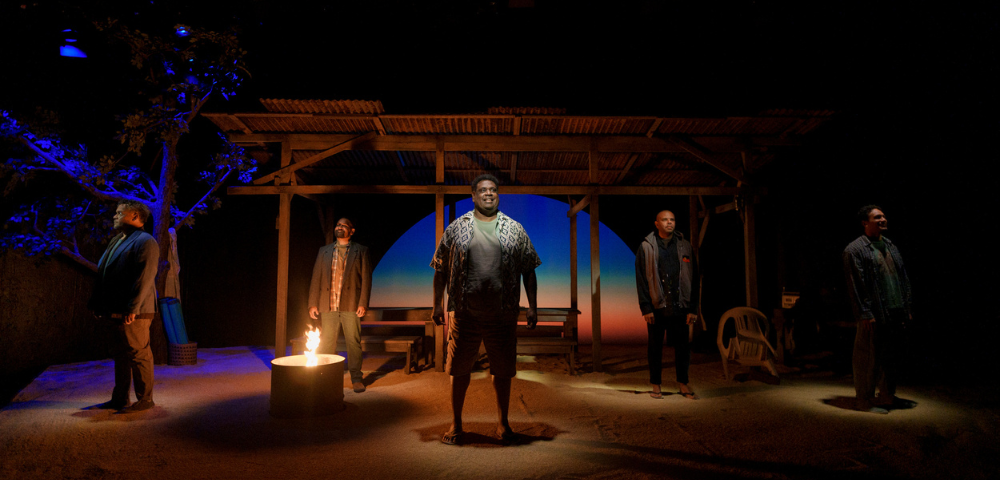
Image: Photo credit: Stephen Wilson Barker
Much more theatrical than its premise may suggest, Dear Son is a genuinely touching production that explores the meaning of indigeneity in Australia within a fractured landscape, adapted from Thomas Mayo’s book of the same name.
Even without knowing the context in which it was created – 12 indigenous Australian men being asked to write a letter to their father and son – Dear Son paints a picture of modern Aboriginal masculinity that reflects on a bitter past, and looks forward to a better tomorrow.
The show, co-adapted by John Harvey and Isaac Drandic (who also directs), is framed as a conversation between five Aboriginal men on one of Australia’s many coasts, set against a beautiful backdrop. Although their roles are more nebulous, the words they speak come from a variety of writers like Stan Grant, Joe Williams and Troy Casser-Daley.
Each letter is indicated with a title, spread across the three acts of this short 70-minute show. I admit I had expected Dear Son to be more or less dramatic readings of these letters, but I was pleasantly surprised to find the show had more of a story than I expected.
That story is admittedly light connective tissue for the letters to shine, but the letters are brilliantly woven together to create a thematic throughline to look to the future with hope. The tales recounted by these actors vary in tone and subject: some are rather solemn, others humorous or bittersweet.
Dear Son is powered by defiant hope
What I appreciated most about these letter excerpts was just how raw they felt: words from that a son will get to read some day, or words left unsaid to a father no longer here. They dig deep into the state of modern Indigenous masculinity and fatherhood; how people perceive it, before taking the steps to powerfully defy it.
That defiant hope is also present in the talented five-piece cast of Dear Son, who each embody different elements of indigenous masculinity throughout. Jimi Bani feels like the impromptu ‘leader’ of the group, equally jovial and fierce when he wants to be.
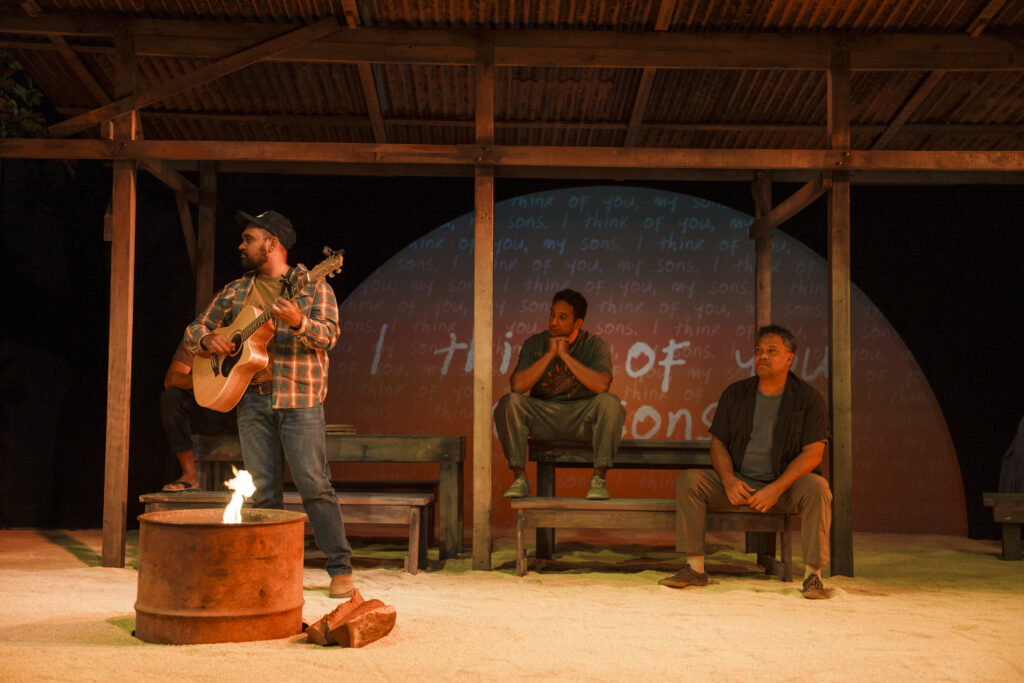
Tibian Wyles steals the show early on by leading a song with his guitar, and Kirk Page embraces nervousness and tenderness in his various segments. Waangenga Blanco delivers a particularly powerful rendition of NRL player Joe Williams’ essay in Mayo’s book, but major props should be given to Aaron Pedersen.
After actor Luke Carroll had to bow out of the show, Pedersen reprised his role from the original Queensland Theatre Company production of this show with barely two days’ notice. Despite a few stumbles, Pedersen was completely off-book for a show he had most recently performed six months prior – if director Isaac Drandic hadn’t explained the situation before the show, I’m not sure I would’ve ever guessed.
That, I think, speaks volumes to the quality of direction and storytelling on display throughout Dear Son. Its willingness to embrace masculine vulnerability and strength to look towards a brighter future is deeply moving thanks to a sensational cast, an astute adaptation and its sense of genuine hope for a better tomorrow.
Dear Son is playing at Belvoir St Theatre until January 26th.