Rememory Echoes Through Sydney’s Biennale with Mara Schwerdtfeger and Tujiko Noriko
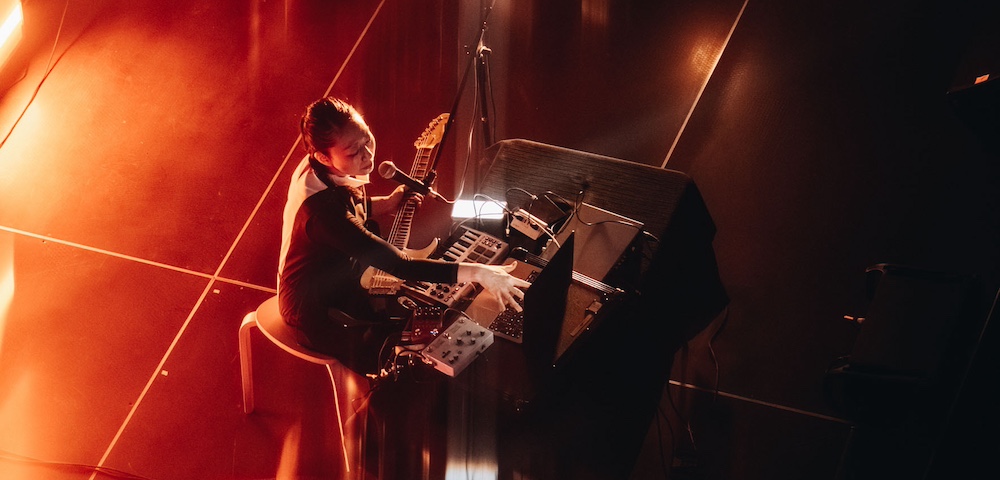
Image: Gabrielle Clement
A gigantic Baobab glows in the centre of the cavernous White Bay Power Station. Its wide trunk is made of flowing petrified cotton. Its thick branches reach to the ceiling. And around it, images of African American slaves play over white tapestries of the same material.
Further inside, a round table is filled with small clay balls. Passers-by are encouraged to roll the seeds of Vietnamese herbs into wet clay and take a dried ball home to plant in their garden. And above a small stage, two vertical paintings loom. White fog stretches between ships as they navigate turbulent seas. A dramatic transience seeps from the stark black and white patterns of indigenous Australian artist Nancy Yukuwal McDinny.
Below, a jagged, sculptural backdrop beams a deep red, and Sydney experimental noise artist Mara Schwerdtfeger takes her place on stage. Lifting the lid of her laptop and holding a bow silhouetted to her violin, the musician readies herself to perform.
The Biennale of Sydney – of which tonight’s performance is part – describes the theme of its 25th iteration as “…the intersection of memory and history, where recollection becomes an act of reassembling fragments of the past – whether personal, familial, or collective.”
Spread throughout Sydney, from the Art Gallery of NSW to Penrith Regional Gallery, artists across diverse cultures around the world have contributed work which interacts with the idea of ‘rememory’. Their artworks prompt us to stop and contemplate how, as a global community, we have arrived – for better or for worse – where we are today, and how we plan to move into the future.
It was with such contemplation that we gathered to witness Schwerdtfeger, and then Japanese electro-pop pioneer Tujiko Noriko perform on March 20: the opening act of the Biennale’s weekly Art After Dark Series, and the first of three organised by Melbourne art collective Liquid Architecture.
In another setting, the effect of tonight’s spacious music might have been different. But surrounded by such diverse and asking artwork, it was hard to forget the theme of rememory. Rather than the music as a focus, the blankets of sound instead seemed to beckon us to fall into our own pasts.
Schwerdtfeger’s music was laced with rumbles and swells – sound which rose with such little edge it appeared to emerge from deep beneath a body of water. Delicate vocals evaporated as they were released into the microphone, and when turning to her instrument, the distorted violin called as if the song of a far-off whale.
Noriko – whose minimal approach to electro-pop contributed to a new wave of ambient music in the 2000s – followed with an hour of achingly slow, echoing ambience. Her fingers would melt into a MIDI-keyboard and pull gently on the strings of a guitar. Each press or pluck summoned waves of oscillating sound to weave in long tendrils into the bodies of the audience before her. Meanwhile, she would use her words as tools of texture. Serene whispers rising, lost within the mix.
Whether sprawled on the ground, staring at the artwork above, or meandering through the various balconies and corridors of the exhibition, a genuine tranquillity possessed the power station.
As fragments of Sydney’s diaspora, it felt as if the memories of the audience were melting together and collecting in a cloud overhead. In this brief community, together with the music which enveloped us, we became for a moment another temporal artwork within this biennale’s exceptional catalogue.
Art After Dark will occur every Friday until June 5.