
‘The Plague’: A Terrifyingly Accurate Depiction Of Young Toxic Masculinity
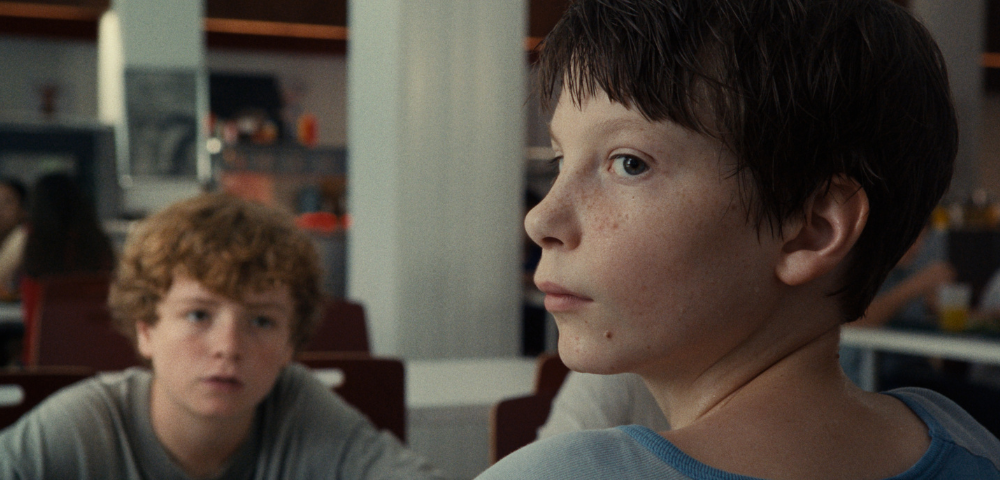
Image: Source: Rialto Distribution
Ever tried and failed spectacularly to fit into a group setting? If so, The Plague might be one of the most upsetting films of the year for you – especially for anybody who was once an anxious teen boy trying out team sports while feeling like he didn’t fit in (I’m not projecting, I promise).
It’s 2003, and the young lad Ben (Everett Blunck) is at a water polo camp for the summer. A socially awkward pre-teen dropped into a team of seeming “cool kids”, he notices that all the boys avoid Eli (Kenny Rasmussen). When he asks de-facto pack leader Jake (Kayo Martin) about this hierarchy, he explains it simply – Eli has ‘the plague’, and it’s something that can spread.
While it’s true that Eli is displaying clear symptoms of some kind of illness, Ben still finds it odd that he is so obviously kept outside the main group. Torn between his sense of empathy towards Eli and a pathological need to fit in, Ben’s world becomes increasingly nightmarish, while the coach the boys call Daddy Wags (Joel Edgerton) tries his best to cool the situation.
As someone who was once a socially awkward young tween, I found writer-director Charlie Polinger’s depiction of young male relationships particularly horrifying. It perfectly captures that feeling you would get when realising you’re one of the lamest people on your assigned team or group project, with your social status only contingent on someone else being more cringe than you.
Paired with some phenomenal cinematography from Steven Breckon and a properly eerie score courtesy of Johan Lenox, the slightly heightened version of reality in which The Plague takes place is gut-wrenchingly scary for the even mildly socially anxious on a regular occasion.

The Plague is a terrifyingly accurate depiction of young toxic masculinity
Part of that undoubtedly lies with the talented troupe of almost exclusively child actors that make up the film’s cast. Great performances from children aren’t in short supply anymore, but this entire cast of boys are genuinely fantastic. Everett Blunck is remarkably committed to the role of Ben, perfectly encapsulating the very tweenage angst of wanting to fit in, yet knowing you can’t do that by being yourself.
His young co-stars inhabit complete opposite ends of the spectrum. Kenny Rasmussen is delightfully painful to watch as the even more socially awkward Eli. It’s fascinating, because he’s probably closest to Ben personality-wise – even if he’s more cringeworthy about it – but his ‘plague-ridden’ status makes him social anathema.
On the contrary, Kayo Martin is perfect at playing that dirtbag from your year 6 class who you think about with resentment looking back. He’s a smartass, cracks jokes and has a surprisingly fragile ego all things considered – but he knows how to control the room to his advantage. This is much to the chagrin of Joel Edgerton’s Daddy Wags, whom the older actor inhabits effortlessly as your nice, if toothless, sport coach.
Although it transforms into something quite upsetting by the end, The Plague doesn’t achieve this by colouring outside the lines of reality. Polinger’s film is so effective precisely because of its observations about young men, and how much of the groundwork for toxic masculinity is laid in these formative moments of their lives. In that, it’s sure to be one of the most unsettling movies of the year.
★★★★
The Plague is in cinemas now.