
Point Danger: Michael Wilding Tackles Dodgy Media & A Suss Bookshop In His New Crime Novel
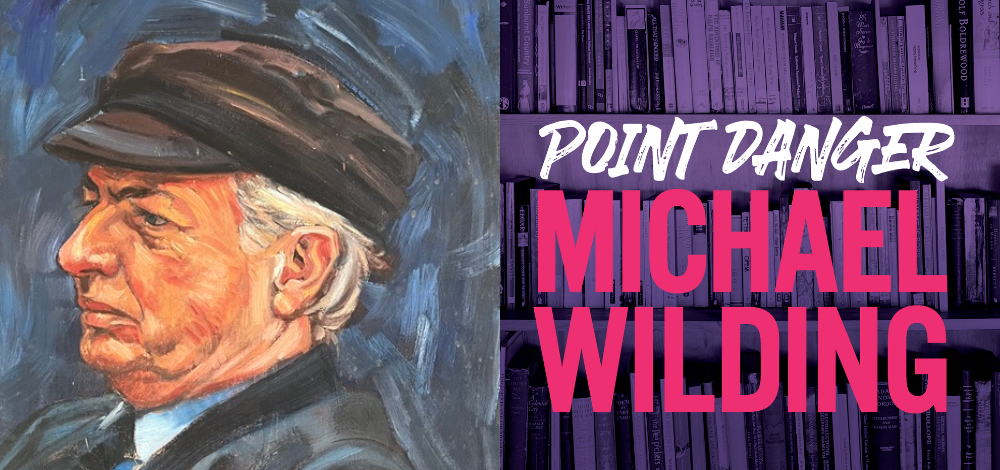
Image: Dmitri
Michael Wilding could have had a nice comfortable career as Emeritus Professor in English and Australian Literature at the University of Sydney, but instead, he turned to crime!
He had already established a distinguished career as a writer of scholarly works about 17th-century and early 18th-century English literature, and about Australian literature. And he had written some 20 works of fiction, some of which were associated with the “new writing” movement of the 1970s and 1980s.
I wrote a review of his last work of fiction, called Superfluous Men, before he turned to crime. Here it is, in part: “Michael Wilding is Australia’s comic genius…[His] satirical edge evokes in the reader not only sly smiles of recognition but outright guffaws of full-blown belly laughter at his well-turned phrase and his sharp insight into the human condition… Michael Wilding’s books will undoubtedly become part of the Australian literary canon in years to come.”
I asked him why he turned to crime.
“After my early fiction dealing with sex and drugs and human relationships, I wanted to deal with political themes. With The Prisoner of Mount Warning (2010) I raised the issue of seemingly oppositional activities being in fact controlled by the secret state. I explored the possibility that an ostensibly alternative, underground newspaper was in fact officially sponsored, in order to contain and exclude radical analysis.
With Little Demon (2018) I examined the possibility that the alternative, hippy-style communes up the north coast of New South Wales were not alternative, but government sponsored experiments in finding ways to rebuild society after a nuclear holocaust.
With The Magic of It (2011), I looked at secret service targeting of radical academics, a theme I continued in Find Me My Enemies (2023).
And In the Valley of the Weed (2016), I focussed on surveillance, a theme running through all the Plant novels, giving them a contemporary relevance, beyond simple entertainment.”
What is it about the genre of crime that attracts you?
“The conventions and expectations of crime fiction allowed me to explore these themes in ways that the more traditional novel was not open to. With the plots of crime fiction I’ve been able to address the current suppression of dissent and radical criticism in the remorseless shift to the right of the media, and the cancellation, the bowdlerising, the censoring and the overall marginalisation of books.”
In his latest Plant novel, Point Danger, Plant is enjoying an indolent but boring life on his lantana farm in the Valley of the Weed when his friend Fullalove, always ready to sniff out a conspiracy, joins him. He visits a Gold Coast second-hand bookshop whose stock has been “sanitised,” for example, “no hard line politics. No dope books.” It is also suspicious that the bookshop doesn’t list its books on-line.
Other characters are Gilbert Osbourne, the dodgy editor of the Byron Bay journal of politically correct opinion, the equally dodgy journalist Shameless Seamus, and the “sexsational” novelist Mandy Mittelnacht and her friend Lucy.
As Wilding notes, “Plant experiences the same ambiguous feelings to alluring females who may well be suspects as those of Raymond Chandler’s classic private eye Philip Marlowe. Though unlike Marlowe he prefers marijuana to whisky. Conan Doyle’s Sherlock Holmes, of course, had his own drug habit, and by the end of Point Danger, Plant finds himself sharing not only that, but Holmes’s ever-threatening plight of boredom. It could be his last case.”
That would indeed be a shame since Plant and his fellow conspirators have become a permanent fixture on Australian fiction’s list of criminal suspects.