

Poetic, Enthralling & ‘Garishly Inhuman’: We Chat To Naarm’s Shock Corridor After Their Sydney Gig
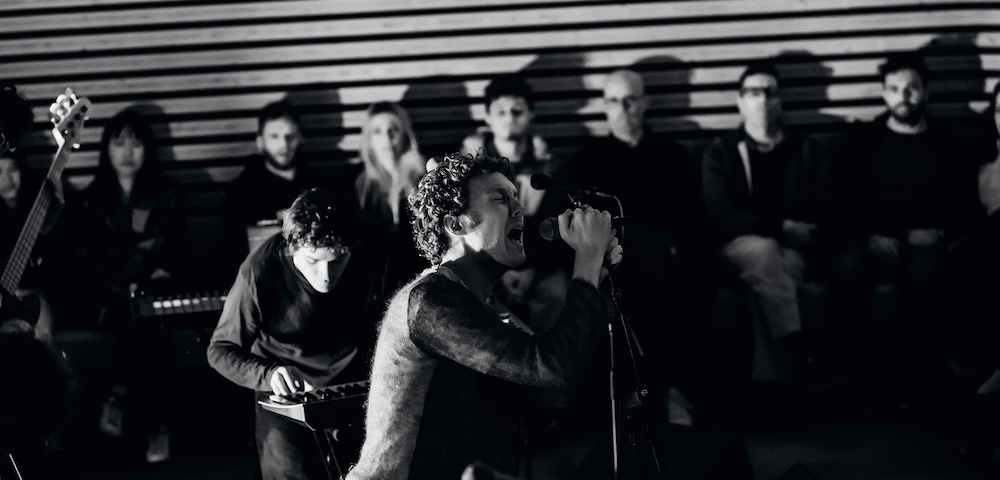
Image: Gabrielle Clement
Deep in pints of cheap lager, I sway outside the seedy late-night Chippendale refuge, Bar Broadway. Beside me, equally unsteady in the 2am cold, stands George Miller – frontman of Naarm post-punk six-piece, Shock Corridor.
As I probe Miller with questions, he describes the intent behind his band’s fierce music. With exuberance, he explains the vision he tried to bring to their performance at Judith Neilson’s Phoenix Central Park earlier that evening (July 30). But ultimately, the most valuable insight the frontman leaves me with – after he and his band slink back to their accommodation to prepare for a looming 8am journey home – is a love poem by the poet W. H. Auden, ‘As I Walked Out One Evening’.
Discovering the poem open on my phone the next morning, reading it bleary-eyed and hungover, I am struck by how well it captures Shock Corridor’s live performance.
While Auden glows with the overwhelming bliss of love, he also caves to the horrors of time. With the mechanical limbs of a ticking clock, in ‘As I Walked Out One Evening’ the poet concludes that time will inevitably tear love apart. Yet, at the same time, he questions if this grim certainty is enough to give up on love altogether.
As I read and re-read Auden’s poem, with every stanza I can see Miller hunched over his notebook in the centre of Phoenix Central Park’s curling space. And around him, I can hear his band open the performance with a new, unrecorded, untitled song – so fresh Miller still hasn’t written lyrics for it.
For the song’s entire eight minutes, Henry Rawling’s bass jitters and slides in the same slow, enthralling rhythm. Saskia Permezel’s haunting violin builds upon itself, slicing with slow unspooling reverb. Synth, beneath the fingers of Joe Nossal, howls a ghostly wind while his drum-machine clatters like the cogs of a factory being kicked into gear.
Paddy Walter’s drums patter almost inaudibly beneath the rhythm, until, like jets of flames, they gush forward with booming toms. And laced within it all, the shimmering electricity of Ari Guthrie’s guitar crackles and cavorts.
It is a sound garishly inhuman. Mechanical and terrifying. And in its centre, his hushed, tortured voice rising like an animal lost in the gears, Miller recites ‘As I Walked Out One Evening’. The words are almost a premonition of the hour to come.
As the band follow with music primarily from their upcoming debut self-titled LP, the audience are witness to a machine brought to life. With trip-hop and post-punk influences grappled together, the music grows limbs and writhes. It reaches out and pulls on us, forcing us to convulse to its mesmeric rhythm.
Meanwhile, Miller desperately grips the microphone. He calls helplessly into it, as if down a desolate tunnel. Increasingly his slurred, wailing, human lyrics – like love in Auden’s poem – are constantly at the mercy of the machinery around him.
This tussle between human and machine comes to a head in the project’s final song. Rawling and Nossal swap their pounding instruments for the brief sanctity of the trumpet. A mournful duet sweeps into the room, collected by a gentle, rising warmth from the rest of the band. Colossal drums shake from Walter’s kit. They build beneath Miller’s voice, which, contrary to the rest of the performance, holds a new confidence – rather than flailing within the machine, he seems to now be clawing out of it.
Here, the frontman recites an adaptation of another Auden poem – ‘Stop All the Clocks’. As he does so, Permezel’s swelling violin offers him a rope to clutch onto. The soaring chords raise him up and hover his words over the machine.
As Auden’s poem concludes, with his eyes clenched shut, Miller drops a match into the gears. Drums implode. Music folds into flames. “I would do anything!” the frontman repeatedly screams. Until, over embers, the band emerge from their performance.
Eyes glimmer at the uproar of applause around them. Then, silently, calmly, they slip off the stage.
‘The clocks had ceased their chiming /’ reads the conclusion of ‘As I Walked Out One Evening’, ‘/ And the deep river ran on.’



Leave a Reply