Opera Australia’s Hansel and Gretel Brings Terror, Humour & Surrealism
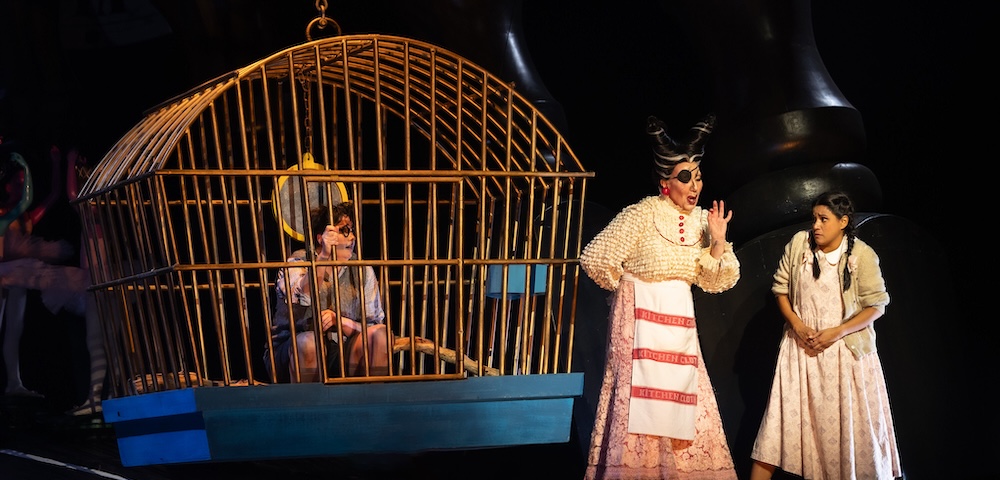
Image: Photo: Carlita Sari
The terrifying fairytale of the Brothers Grimm, Hansel and Gretel, returns to the Australian stage 24 years after director Elijah Moshinsky first presented his enchanting version to Opera Australia audiences.
Under the baton of Tahu Matheson and the guidance of revival director Claudia Osborne, the opera delighted the full house on opening night, which probably included many from the monster passenger ship berthed opposite.
It was a thrilling production in which the orchestra emphasised the various leitmotifs of Humperdinck’s score, contrasting the playfulness of the siblings with darker strains that foreshadowed the terrors of the night and the presence of the evil witch. The influence of Wagner appears in the score early as the French horns introduce the work.
The surrealistic staging by Mark Thompson evoked gasps from the audience as they watched the children walk down a rabbit-hole of enlarged floorboards, massive banisters, and a huge clock face without hands in a set reminiscent of Salvador Dali’s paintings or perhaps Lewis Carroll’s tale of Alice.

David Pountney’s translation of the libretto written by Humperdinck’s sister Adelheid Wette allowed for moments of local humour, such as when the siblings opened their food parcel to find it contained – “VEGEMITE!”
Margaret Plummer, mezzo, in the pants role of Hansel, and soprano Stacey Alleaume as Gretel were charming as the siblings who quarrelled, made up, embraced and cared for one another. Their gentle evening prayer duet was a high point of the evening.
Despite their neglect of their children, the careworn stepmother (Helen Sherman) and drunkard father (Shane Lowrencev) came good in the end, although the mother was sent off to heaven accompanied by angels in the children’s dream in the forest.
Jane Ede, as the witch, in a wonderful costume designed by Mark Thompson, was as humorous as she was frightening when she sang “Greedy little mousey, Who’s nibbling at my housey”, while Kathryn Williams and Shikara Ringdahl were captivating as the Dew Fairy and the Sandman.

The ungainly dance of the fairies, which drew audible laughs from the audience, was surely an indication that good would win out over evil in the end, as indeed it does.
Mark Thompson’s cage which descends to the stage to capture Hansel, the oven in which the witch intends to cook him, and her sugar house are the phantasmagorical elements of a dream – or a nightmare – realised on stage.
I could not fault the singers, the staging, the direction, or the orchestra, but I do wonder why the most dramatic element of the fairy story – Hansel repeatedly sticking his finger out of the cage for the witch to feel – did not occur at the end of Act 1, where it would have had full impact, rather than towards the end of the opera. No matter. It was a wonderful experience.
It was unfortunate that Humperdinck did not get the job of Director at the Sydney Conservatorium of Music when he applied in 1914. I’m sure you know why.