
‘From Winter’s Stillness’: Australian Chamber Orchestra Conjures A Scandi Winter at Sydney Opera House
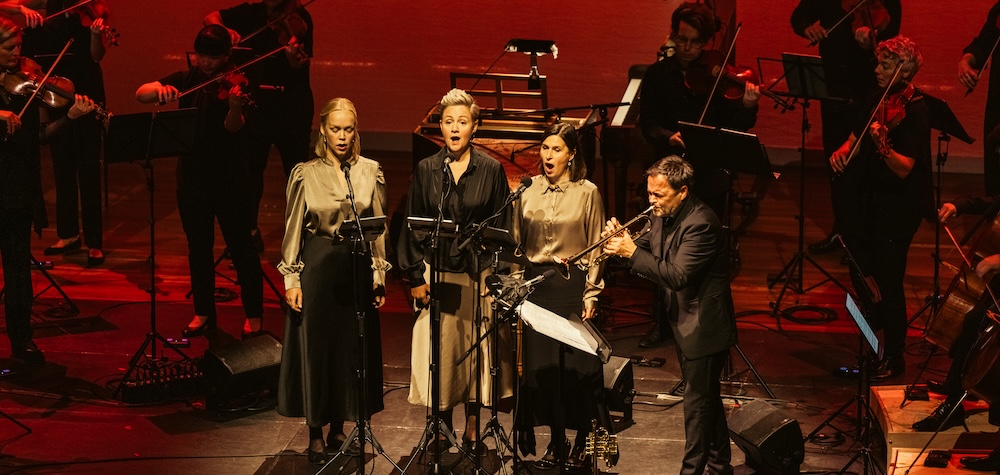
Image: Charlie Kinross
Rain threatens to fall. Squalls of seagulls scour Sydney Harbour for fish. Drabs of sightseers fight the blistering wind to take photos with the black monolithic bridge behind them.
It is the intermission of the Australian Chamber Orchestra’s ‘From Winter’s Stillness’ at the Sydney Opera House Concert Hall (August 9), and I’m standing on the back deck of the famous building watching this grey vision unfold below me.
The first half of the performance is still fresh on my mind, and – as is the concert’s intention – I find it difficult to separate the music from this winter before me; so bleak and bitter, yet remarkably so full of colour.
‘From Winter’s Stillness’ is a collaboration between the ACO, Norwegian jazz trumpeter Arve Henriksen, and Nordic folk singers Trio Mediæval.
Stringing together compositions ranging from medieval to newly commissioned, the concert aspires to capture the mysticism of Scandinavian winter and collide it with new worlds.
Today – the concert’s final stop along Australia’s east coast – the world it collides with is this wind-whipped Sydney Harbour; and from what I have seen so far, few musical experiences could better complement it.
The opening was quiet. It began with strings which sounded first like the crackle of ice over a lake, before evolving into sombre, tranquil orchestral passes. Over this, as he stood facing the strings, both conducting and delivering his work ‘Plume of Ash / Acceptance’, Henriksen’s trumpet sang with such a mournful tone you could not help but feel a small sadness for the musician.
ACO Director and lead violinist Richard Tognetti took the role of conductor from Henriksen – violently swinging both hand and bow to draw a ferocious rendition of Terry Riley’s ‘Half Wolf Dances Mad in the Moonlight’ to the hall. Then, as Trio Mediæval finally strode to centre stage, the audience was carried elegantly, and ceremoniously by their interweaving voices deep into the ice of Scandinavia.
Helmed by the Trio, and then finally Henriksen’s voice, the orchestra performed four more pieces – one a commission by Academy Award-winning composer Hildur Guðnadóttir. Yet so exceptional was the landscape they constructed with these pieces, that to an untrained ear as the strings, trumpet and ancient language flurried together, there seemed no distinction.
Instead, like gentle snow over a mountain range, I felt slowly buried by a complete vision of winter. Therefore, as I enter the hall again – beckoned off the back deck for the second half of the concert – how shocking it is to be faced with horrors.
The entire second half is made of Alfred Schnittke’s Concerto Grosso No. 1, interleaved with medieval hymns by the Trio. The result is a deeply unsettling score, as if now we leave behind the beauty and comfort of winter, and instead dig into its harrowing core.
We open first with discordant upright piano from Simon Tedeschi – who later moves to a Ruckers Double Harpsichord. The strings which follow for much of the next forty-five minutes resemble the sighs and moans of a river of ghosts. They curdle and spin, erupting into screaming maelstroms before sharply cutting out to allow room for the Trio’s glowing hymns.
In these moments, when each torrent of strings cuts out, and before the Trio briefly enters, a murmur runs through the hall. There is a real feeling of disquiet, as if we have been misled – lured into a false sense of security, then attacked with as much venom as the orchestra can fathom.
This comes to a head when, at the conclusion of the final interlude, before the orchestra can begin spiralling toward its conclusion, Henriksen leaps in with his trumpet.
An out-of-control, high-pitched squeal races into the hall. The trumpeter writhes as he appears to try to hold onto his instrument. He thrashes, and fights. The squealing grows faster, more violent, until suddenly with a sharp – apparently astonished cry – it leaps from his mouth. I am almost shocked when he holds onto it. If it had instead flown possessed through the room, I would not have been surprised.
Similarly, in one of many moments where Tognetti and fellow lead violinist Satu Vänskä trade blows of savage, increasingly rapid strings, Vänskä – with her face obscured by her hair – throws her instrument away from her body and unleashes a blood-curdling scream.
These two moments – Henriksen’s battle with his trumpet, and Vänskä’s scream – are not in Schnittke’s original composition. Their addition brings a haunting spirituality to the piece and speaks to how well the ACO have adapted it for the theme of Scandinavian winter.
Coalescing with the hymns of the Trio, it gurgles with an extraordinary feeling of dread.
Ultimately, like the enormity of winter or the indecipherable beauty of a sprawling landscape, there are few words which can describe the feeling the concert leaves me with.
Instead, as I leave the Opera House and plunge into cold rain now falling, it feels like Sydney’s winter is doing that for me.
Leave a Reply