
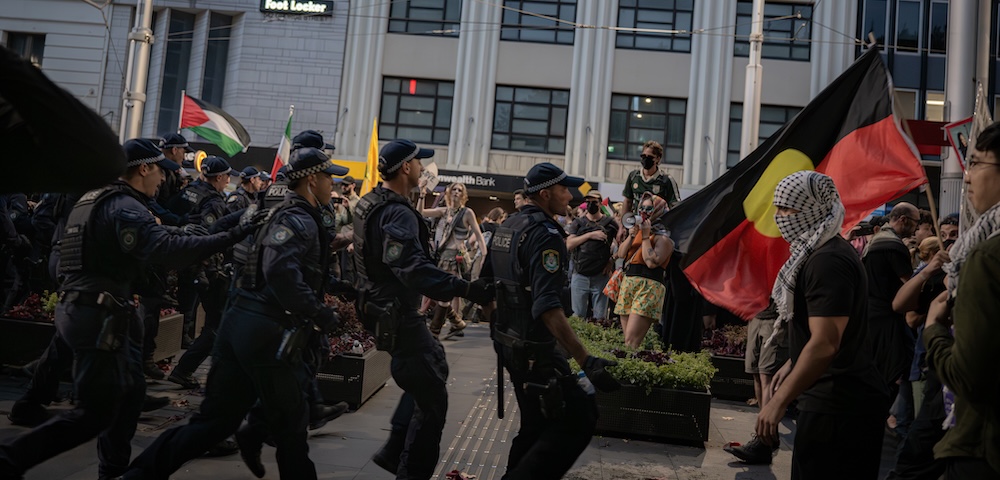
Image: Police officers advance toward demonstrators to disperse a crowd near SydneyÕs Town Hall, Monday, February 9, 2026. People are protesting against Israeli President Isaac HerzogÕs visit to Australia. (AAP Image/Flavio Brancaleone)
First Nations activists alongside a broad coalition opposed to the Minns government’s anti-protest laws have put forward a case challenging the constitutional validity of the laws, which is set for hearing on February 26.
Since the Public Assembly Restriction Declaration has now lapsed, they’re asking for changes to the Major Events Act.
The group says that NSW Premier Chris Minns’ anti-protest laws and demonisation of pro-Palestine protestors incited mass police violence against peaceful demonstrators last Monday night during the visit of Israeli President Isaac Herzog.
The government announced it had declared the visit a major event under the Major Events Act. The legislation is typically invoked to manage crowds during sporting events, such as March’s AFC Women’s Asian Cup.
As part of their call for accountability and justice, the group is demanding changes to the Major Events Act (2009), to remove the current restrictions on the civil liability of police. Under the Major Events legislation, which was at play during the violence clash between police and protesters on Monday, police are given more powers to control protesters, while at the same time limiting police liability for anyone harmed by police while implementing those powers.
Paul Silva, a Dhungutti activist involved in the litigation, said:
“As a sovereign Dhungutti man I have refused to accept the Minns’ government’s attempt to silence our voices. The Public Assembly Restriction Declaration (PARD) was first altered to facilitate our march on Invasion Day after we pledged to defy any laws that stopped us marching.
“Aboriginal people were also on the front lines in support of our Palestinian brothers and sisters last Monday night and called for the crowd to take the streets. The attack against us was completely unprovoked… But we will not be intimidated and will continue to campaign in the courts and on the streets to remove all restrictions on our rights to demonstrate and speak freely.”
Days after the Bondi massacre the government passed laws giving police the discretion to ban authorised public assemblies, a fortnight at a time, for up to three months following a terror attack. Protest groups are challenging the law underpinning the prohibition which has been extended four times already.
However on Tuesday, NSW Police Commissioner Mal Lanyon announced that the controversial restrictions on protests in Sydney’s CBD and eastern suburbs had not been extended. The laws have been in place since Christmas Eve.
The laws grant police the power to refuse authorisation for public protests for up to 90 days after a terrorist incident, restricting demonstrations in certain areas. The restrictions do not actually ban protests but rather remove certain legal protections for protesters, including exemptions relating to traffic obstruction and public order offences.
“Now that the PARD is no longer in place, and the LECC (Law Enforcement Conduct Commission) has established a full investigation, it’s time for the government to fix the harm that it has done,” says Greens MP Sue Higginson. “That’s why I’m calling for the Government to guarantee that any civil compensation arising from police violence at the Town Hall assembly, will not be avoided through the Major Events declaration that the Premier made.”