
‘Acts Of Protest’ Spotlights The Heroism Of Local Collective Action & Protest
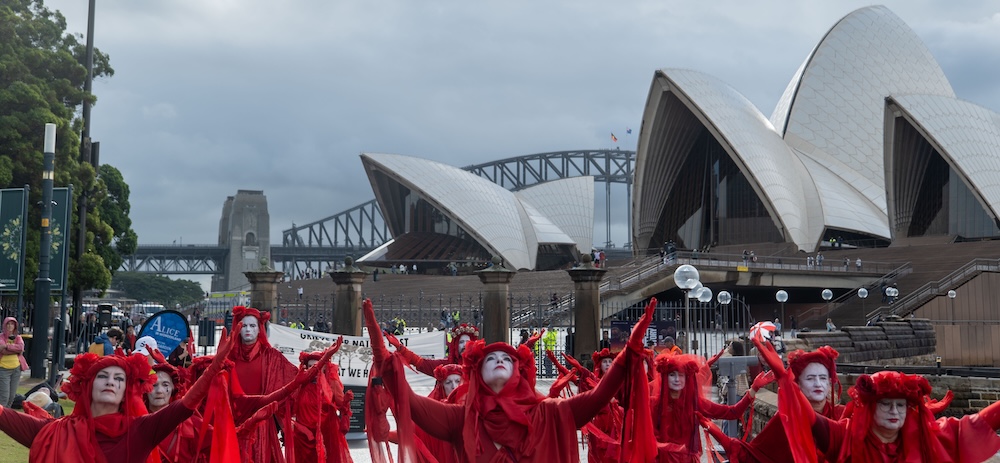
Image: Zebedee Parks
An elderly woman draped entirely in red with a painted white face streaked with black tears outside the Opera House; people scrambling up a freight train carriage loaded with coal; contemporary dancers continuing to move to imaginary music as they’re dragged away by police.
These are some of the scenes in Zebedee Parkes’ 7-minute documentary Acts of Protest, the culmination of his masters degree, which will be aired at this year’s Antenna Documentary Film Festival.
Acts of Protest takes its audience through years of civil disobedience across the country, and Parkes – a filmmaker and photojournalist – has become a common sight at protests around Sydney over the last few years, documenting moments of hope, grief and justice as communities across the state speak out.
Acts of Protest lets Parkes’ work speak for itself — there’s no narrative through line or central character to follow, but you’re nonetheless engrossed as you watch everyday civilians put their bodies on the line, trusting not only in the people around them to keep them safe, but in the validity of the cause.
“I’ve always felt very passionate about the need to be representing the collectivism of activism a lot more, “ Parkes said. “Too many activist narratives reflect just sort of one hero as an individual, and they don’t represent all the other people that are involved and part of campaigns that often will eventually make change happen.”
Parkes invests fully into this break from traditional story-telling arcs, forgoing any narration or voice over providing context to the protests, relying on the audiences’ sense of compassion, justice, and the knowledge they already have of the causes.
“When we were trying to find the structure for the film, we actually found that to be more powerful, an invitation for people to actually think of what the film’s saying and think of their own relationship to it, rather than just having a film that’s telling people what to think,” Parkes says.
In this way, Parkes invites the audience members to centre themselves in the story instead, to realise that these strangers marching through the street are not simply nameless public nuisances, but our colleagues, neighbours, the people we grew up alongside, standing up for a cause they believe in.
The viewer may have already been part of a protest themselves. 300,000+ people marched across the Harbour Bridge for Palestine and many Sydneysiders were arrested in Rising Tide People’s Blockade blocking coal ships last year, Extinction Rebellion protests (which the doco heavily features) are becoming a common sight, and Invasion Day protests to mark January 26 are becoming more mainstream.
It comes at a time in which the New South Wales government has been steadily criminalising protesters. In the last year, legislation has been passed outlawing protest near a place of worship, restricting formal authorisation of protests for a period of time following a terrorist attack, and massively expanded police powers.
“In recent years, I’ve definitely seen an escalation in terms of the policing of protests in terms of being more aggressive to protesters,” Parkes said.
“I’ve seen other Premiers find protests kind of annoying, and support various anti protest laws, but Chris Minns seems to have a particular personal agenda of cracking down on protest.”
If anything, these laws have helped people to realise how important their voice is, and the ways it can be strengthened with the help of others.
Now, more than ever, the power of collective action is being felt.






Leave a Reply