


Image: Powerhouse Museum / Facebook
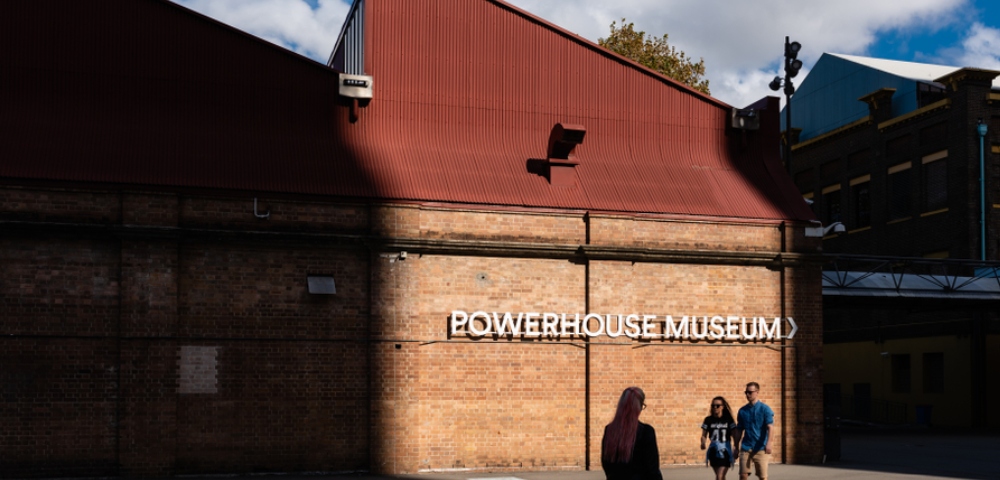
There is concern in the local community as the Minns Government reportedly weighs whether to curtail upgrades to the iconic Ultimo Powerhouse Museum — or even to sell it.
On 5 September, the Sydney Morning Herald reported that “the highest levels of government” were considering various options, with the ongoing renovation on track to overrun its $300 million budget by $80 million. Amongst the apparent possibilities are the sale of the Harwood Building containing offices and workshops, the mothballing of the entire Sydney landmark, and its sale after upgrades bring it up to present standards.
A preliminary assessment of the Harwood premises’ market value is underway. The 2020 rejection by the Heritage Council of a proposed listing for the entire Powerhouse site leaves the building, a former tram depot, unprotected.
The Museum of Applied Arts and Sciences — as the Powerhouse is also known — is under pressure. Its CEO Lisa Havilah left her role in late August amidst an internal investigation into “governance and procurement practices,” though she reportedly hopes to return. Chief Operating Officer Mark Weldon stood aside at the end of July, to be temporarily replaced by state Treasury executive Cassandra Wilkinson.
The opening of the Parramatta site is slated for 7 November.
Budget overruns “extensively foretold” – community group
The Friends of Ultimo community group has spent years campaigning on the museum, having opposed its complete closure and relocation which was subsequently abandoned by the Berejiklian Government.
“We understand that the New South Wales Government is currently considering all possible options to reduce the costs of the Powerhouse Museum Ultimo so-called ‘heritage revitalisation’.”
“The project involves replacing a revered, world-class applied arts and sciences museum with two inferior function and entertainment centres — not museums — in Ultimo and Parramatta. The totally unnecessary project costs around $2 billion to NSW taxpayers.”
“The entire Wran Building and Galleria has now been demolished, despite the complex being listed on the State Heritage Register in July 2024.” The Wran Building, which arts minister John Graham campaigned on saving, is to be totally rebuilt.
“The budget overruns now emerging during construction, together with forecast unsustainable future operating costs, were entirely predictable. This must be one of the most extensively foretold debacles in NSW.”
A “revitalised” museum cannot function without the Harwood Building, the group further argued.
Downsizing museum “would be a disservice” – MP
“Cultural institutions, like the Powerhouse Museum, play an important role in Sydney’s history and tourism,” independent Sydney MLA Alex Greenwich told this masthead.
“The Powerhouse has strong links to local creative and innovative hubs, as well as the converted electric tram power station it occupies. The community would strongly oppose another attempt to empty the Powerhouse of the important cultural, scientific and artistic stories it has told for more than a century.”
“Mothballing or reducing the scope of either the CBD or Parramatta sites would be a disservice to the museum and the community.”
Neighbouring Greens Balmain MLA Kobi Shetty concurred. “Our community fought for over a decade to stop the demolition and sale of this important cultural icon in our city,” Shetty wrote on Facebook.
“Right before the last state election, John Graham stood in front of the Powerhouse with the then Labor candidate for Balmain to announce that the Powerhouse would not be demolished or sold, but would be renovated and reopened for our community.”
When approached for comment, the Department of Climate Change, Energy, the Environment and Water — which is responsible for heritage as well — referred the City Hub to Infrastructure NSW, who did not respond prior to publication.



This story is right out of the department of, “We told you so.”
This is why community members advocated for heritage protection of the whole complex. We strongly suspected that the minute we lost any of it, we’d eventually lose all of it.
The minute someone said, “ohhh, the construction of the 1980s building isn’t heavy enough to support our massive brick uni—I mean WORKSHOP — block structure we want to build in front of it, looks like the original has to go because if it’s a choice between the exxy new brick structure we dearly want and the original, we pick the exxy new brick structure”, the die was cast.
Anyone who’s been around Sydney for more than a decade knows that structures of the vintage of the 1988 Powerhouse Museum contain asbestos. And this would especially be true of a *museum* containing key artefacts. For them to start knocking it down and *THEN* say, “ooooh, we just realised there’s a lot of asbestos here… gonna cost a lot to remove it… there goes the budget…” is inexcusable because a reasonable person would have foreseen this when considering what to do about the mismatch between new building engineering and existing building structural constraints, before making a decision to demolish the old in favour of the new.
The financial non-feasibility was a reason to stop and revisit the costly new brick structure whose engineering wasn’t compatible with the existing facility. But that’s not what they did. Why?