
‘Star Wars: The Mandalorian and Grogu’: Lost in a Galaxy Far, Far Away (& Not in a Good Way)
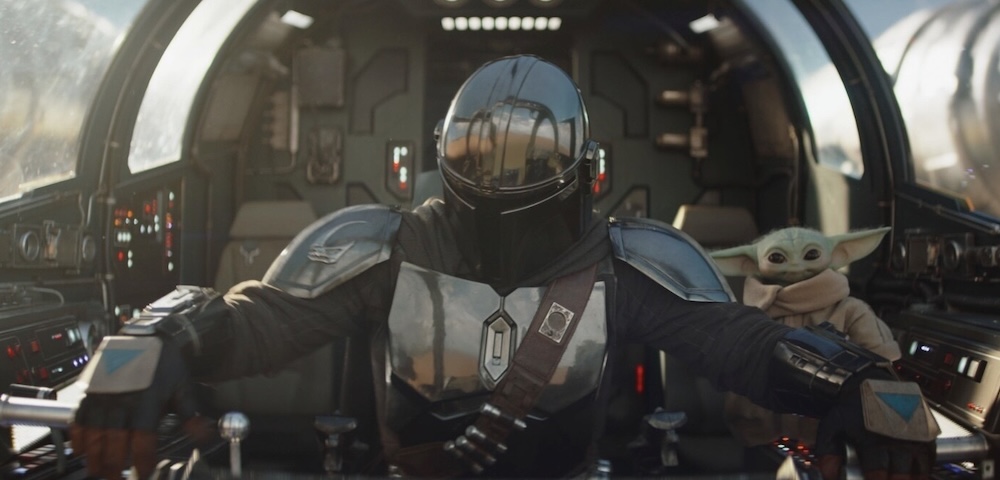
Image: via Disney
To many, the Disney Plus show The Mandalorian resides as one of the biggest revitalisations of the Star Wars universe, hitting at the heart of what made the original films so special, whilst also carving out its own identity and story set after the fall of the Galactic Empire. For the first time in seven years, Star Wars returns to the big screen with Star Wars: The Mandalorian and Grogu that stands as a continuation of the show, and as a jumping on point for new viewers.
Whilst the return to the big screen affords the film grandiose and expensive set pieces and cinematography, the eye candy, myriad action scenes and a star cast do little to counter the lackluster storytelling and unsubstantial script.
Though entertaining as a galactic romp, the film’s referential nostalgia bait and confused identity drive the overwhelming feeling that Star Wars: The Mandalorian and Grogu is less of a filmic endeavour, but more a part of a corporate marketing strategy that struggles to justify its own cinema existence.
The plot follows Mandalorian bounty hunter Din ‘Mando’ Djarin (Pedro Pascal) and his adorable green companion Grogu as they’re tasked with capturing Jabba the Hutt’s grown son, Ratta (Jeremy Alan White) at the request of Jabba’s twin siblings so to expand the reach of their criminal cabal after failing to do so in Star Wars: The Book of Boba Fett.
The duo encounter criminals, droids, creatures, imperial sympathisers, and are double crossed, led astray and forced to uncover the importance of Ratta to the plans of the Hutts.
The film is meant as a continuation of series’ The Mandalorian and The Book of Boba Fett, however, the story has almost no links to the past shows, so much so that the characters, world building events of the show’s three season run time are mostly ignored, say for a few references, and recurring central characters.
In doing so, the film tries to position itself as independent of any previous Mandalorian or extended Star Wars storylines, and thereby as a gateway for audiences that are less knowledgeable of the Star Wars brand or Disney show.
In this regard, those who are less inclined to call themselves fans of the brand will likely take the film at face value and enjoy it as a galactic space romp where Mando tries to complete deadly contracts whilst babysitting his adoptive green son, and teaching him life skills, like flying ships and shooting space criminals, with a few jokes thrown in.
However, those in the fandom, like me, will likely be fatigued by the repetitious plot beats and character development already undergone throughout the tv show, rehashed for the sake of newer audiences.
This leaves Mando and Grogu with no satisfying character development and a storyline that’s sole purpose is to guide us from one action scene to another.
One could imagine that with Grogu being included in the film’s title, he would garner more of an agentic role in the film. However, the action and screentime bring to light how underdeveloped and unrealised the character is.
The youngling does take a more active role in the film and does come to rescue Mando numerous times, but the times where Grogu does contribute has little to no consequence to the plot, so much so that even in the 20 minute segment that has Grogu at his most independent from Mando, he merely stumbles into or is handed the solution to conflict by random characters, in an underserved deus ex machina moment.
Star Wars back on the big screen
With that said, the budget is on full display from the first scene, and it is magnificent. Whilst not a cinematic revolution, through a combination of hyper detailed physical sets, unrestrained CGI from ILM and strategic use of The Volume screen gives the IP a more realistic and immersive presentation that the tv series couldn’t dream of.
From the vast plant-scape of Nal Hutta to the inside of Mando’s ship, the Razor Crest, the world director Jon Favreau creates feels lived in, tangible, and full of history just outside of view for the audience.
This technological wizardry extends to the character and creature designs too. Returning character Garazeb “Zeb” Orrelios’ (voiced by Steve Blum) CG character returns looking better than ever interacting with the characters and set in such a way that you forget he was not physically there. Newer characters like shop vendor Hugo Durant (Martin Scorsese) extend the sense of a realised world with his stall feeling tailor made for his character, who knows the intricacies of every nook on screen.
I will say however, myriad action set pieces do fall flat. Brendan Wayne and Lateef Crowder as stunt performers for Pascal do a phenomenal job of bringing agency and combat readiness to the character in fight scenes, straddling the line of smart choreographed fighting and sheer brutality, but the presentation and cinematography fail to fully display their capabilities, reminding me of the meme-ified incoherently cut scenes of the Taken films.
The inertia of the action is hampered by trying to appease all audience quadrants in some moments but also display brutality in others. This to me leaves all the action scenes without suspense, that the main characters are in no sense of danger. This feeling is justified more when entering the cinema, trailers for Minions, Spider Man and an ad for a Grogu plushie played beforehand, yet enemies are torched to death by Mando’s flame thrower.
But who is ‘Star Wars: The Mandalorian and Grogu’ for?
As alluded to, the film tries to be both a continuation of the show, and as a jumping on point for new viewers. In this attempt to appease both audiences, I feel like the film fails miserably to satisfy both parties and ends up feeling like a way to sell more Disney plus subscriptions and Grogu plushies.
The decision by the writers – Dave Filoni, Noah Kloor and Jon Favreau – to make the film a standalone experience may leave fans unimpressed and like they are a side thought in the film making process; the meandering plot and little character growth makes this film feel like a bloated and indulgent episode of the show that’s only reason to exist in theatres is to fill in the time until the next mainline film’s release.
The flip side of this, is whilst it does seem to be a gateway for new audiences, they may be left confused by the film. Scenes throughout inject nostalgia bait and easter eggs from the franchise, however without being in the know, scenes will fall flat and feel like indulgent filler halting what little momentum the film built up.
On a larger scale, the film’s utilisation of characters and areas form the larger universe – Like the Hutts and Zeb – demand the audiences to have prior knowledge of Disney’s less than stellar filmic output over recent years, and animated television shows; potentially dozens of hours of prior viewing.
All in all, Star Wars: The Mandalorian and Grogu to me feels like a hollow reminder that the franchise is owned by the world’s biggest media conglomerate. It visualises an expansive world but fails to do anything new with it. The series has near infinite characters and plots to call on to tell new and interesting stories but play it safe with exhausted characters and plots that generously feel self-contained, and at worse lifeless and uninspired.
What’s more is Disney plus has over 150 million active subscriptions, yet Disney asks people to pay to watch this overly long and bloated episode theatres, when it would make more sense to release on the streaming service. Regardless, if you enjoy a mindless space adventure with action to pass the time and an adorable green gremlin to awe at, wait until it is available on Disney Plus in September.
Leave a Reply