Woman Awarded $93,000 In Damages After Illegal Music Festival Strip Search
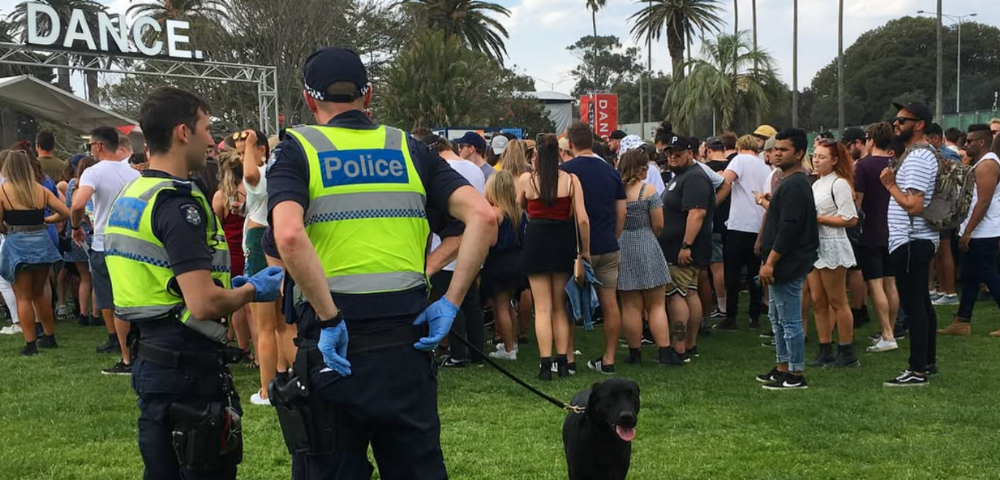
Image: Police at Listen Out Music Festival via Instagram (@victoriapolice)
A Sydney woman subjected to an illegal strip search by police at a music festival in 2018 has been awarded $93,000 in a landmark lawsuit that could see thousands of other festival strip searches carried out between 2018 and 2022 deemed unlawful.
Supreme Court Justice Dina Yehia handed down her findings on Tuesday in relation to a class action brought by Slater and Gordon Lawyers and the Redfern Legal Centre against the state of NSW, finding lead plaintiff, Raya Meredith, was subject to “humiliating” treatment at Splendour in the Grass Musical Festival in 2018.
Meredith, who was aged 27 and postpartum at the time, was taken into a makeshift tarpaulin tent after a drug dog sniffed in her direction, where she was made to remove her clothes, bend over, lift her breasts, and remove her tampon.
In the middle of the search, a male officer walked in unannounced.
Police didn’t find any drugs during the search.
Speaking in an emotional testimony on the first day of the action in May, Meredith said the ordeal was “a horrible thing to go through”, and told the court of the years of “gaslighting” she endured after police denied her experiences.
She has been awarded $93,0000 in damages, including $43,000 in compensation and $50,000 in aggravated damages.
The finding comes after police admitted in court documents days before the action began that Meredith’s strip search was unlawful and unjustified, withdrawing 22 witnesses prepared to contest her version of events.
“I can say with absolute honesty that I am glad it’s over,” she said in a statement.
“It’s been harrowing and traumatising, yet at the same time I am incredibly proud of myself and my bravery, and the bravery of those whose voices back my own with their stories and experiences.”
“NSW police have admitted fault by me and now need to take ownership for the wrongdoings to the rest of the class.”
Action could see thousands of people compensated
Meredith is just one of the three thousand people signed onto the class action, although the number of people impacted by illegal strip searches could be twice as large, with lawyers saying the state may be made to pay “potentially millions” of dollars.
Yehia’s judgement highlighted that none of the police records identified how the requirements for Meredith’s strip search, or the other 143 strip searches carried out that same day were met.
Speaking to media outside the court, senior associate at Slater and Gordon Lawyers, William Zerno, said Meredith’s experience was “not an outlier”.
“[It] was experienced by thousands like it. Minors were strip searched. Some people were subjected to cavity searches, and people were strip searched in public view and were asked by New South Wales Police, in some instances, to remove tampons,” he said.
Zerno said it was the largest class action against any police force in history.
“The evidence that was led in this proceeding that the New South Wales Police undertook searches on industrial level at festivals and with little or no regard to the legislative requirements or safeguards which are intended to check these powers,” he said.
“This has significant and far reaching indications, and we believe that this will render 1000s of strip searches in this setting unlawful.
“We’re urging the state to bring this shameful chapter of police abuses to an end and negotiate a settlement for the remainder of the group.
Samantha Lee, a senior solicitor at Redfern Legal Centre, said the case had been spurred on “by the courage of young people and children”.
“It is their courage that has brought this case before the court.
“What [the] message from this case is ‘police get your hands off young people and children’s bodies’.”
The class action relating to thousands of more strip searches at music festivals will return to court at a later date.