
Image: AAP Image/Michael Currie
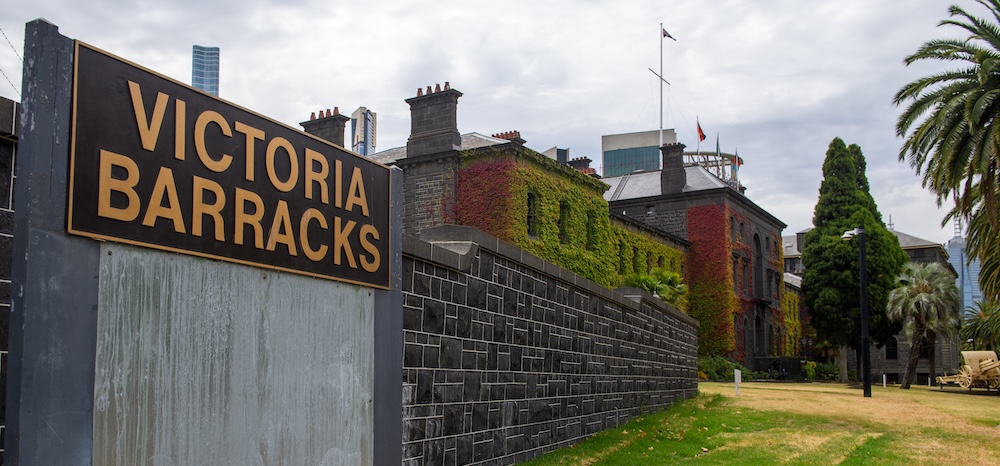
The Victoria Barracks, on Oxford Street in the Sydney suburb of Paddington, a site mentioned in so many tourist Guide Books, is not – as some Consultant’s Report might suggest – just a piece of land that could be sold off to developers to help the Federal Government’s Budget. Rather, it is an iconic piece of Australia’s ‘intangible heritage’, a site steeped in the Nation’s history.
The 1840s was a tumultuous decade for the colony of NSW that, while it saw the formal end of convict transportation in 1840, also experienced a major depression in the following years. And while that economic slump slowed the colony’s growth, other developments occurred that helped shape so much of our history, with one of particular significance.
It was Governor Bourke’s decision to move the Military Barracks, which housed those ‘licentious’ soldiers of the New South Wales Corps from Wynyard Square that kick-started an important fragment of Australia’s intangible heritage history. The new site eventually chosen for the Barracks was located ‘two miles distant from Hyde Park along the South Head Road’, and the site was well chosen strategically; it had views out to both the entrance to Botany Bay and across to the Heads at the entrance to Port Jackson.
The new Barracks were designed by Lieutenant-Colonel George Barney, the first Colonial Engineer, and it was the commencement of construction there in 1841 that saw a village of sorts begin to emerge around it. Many of the cottages nearby were built for the many artisans – stonemasons, quarrymen, carpenters and their labourers – who were working on both the construction of the Barracks and the dwellings of the small community that grew up to supply goods and services to them and to the military establishment ; this was the origins of the suburb of Paddington.
There was one minor discontent because of the toll-bars on the South Head Road ,at the beginning of Glenmore Road:
It was a particularly unpopular toll, as everyone travelling to and from the Barracks had to pay, and all produce, etc. supplied to the Barracks was dearer because of the extra toll fees the vendors paid
Some of the skilled stonemasons working on the Barracks were Quebecois political prisoners, transported from Canada as punishment for their involvement in an aborted insurrection in 1836.
When Barney returned to Britain in 1844, the work was taken over by Major James Gordon, and the Barracks was finally completed in 1848.
And its impact spread widely in unexpected directions. The old manse of the St John’s Presbyterian Church had been built in 1845, reputedly using surplus stone from the construction of the nearby Victoria Barracks.
Over the decades, Paddington gradually experienced a population influx, with the Barracks and its inmates still having an influence. Whereas in 1840 its population was a mere few hundred, this had grown to nearly 1400 by 1851 with the completion of ‘Barney’s Barracks’, as they were called. And from then on, it grew rapidly; in 1861 Paddington was home to 2,692 persons:
the village soon began to boast stores, produce merchants, water carriers, wheelwrights, blacksmiths, turnkeys, dairymen, a baker, a local midwife, and being close to the barracks, the inevitable house of ill-repute
Along the Old South Head Road more taverns opened, well patronised by the soldiers from the Barracks, many of them young men without family ties:
Pubs and taverns – with their lively atmosphere, the music of the accordion and fife, streetwise barmaids and a spot of betting on the side – thrived a few paces down the road from newly-built churches and schools.
And on 1 January 1901, celebrating the inauguration of the Commonwealth of Australia, the Federation Parade, including troops, dignitaries, and military escorts – including the New South Wales Lancers escorting the new Governor-General – set out from Victoria Barracks.
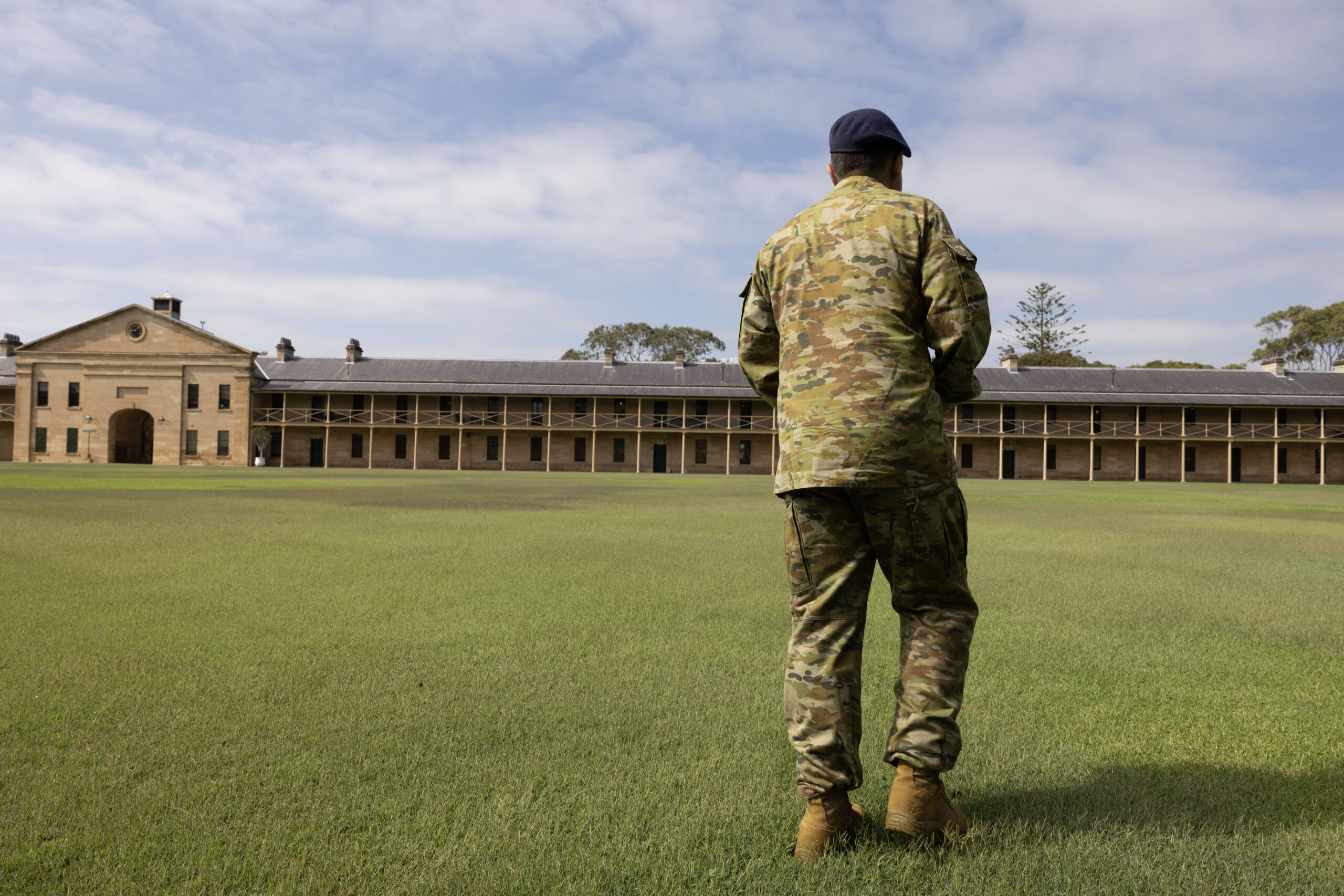
Victoria Barracks were also the site from which many Australian soldiers went off to war. There were many parades of soldiers leaving the Barracks for overseas action, as when they went off to the Sudan War in 1885; the Boer War in 1899-1902; and the so-called ‘Great War’ of 1914-1918. This last was a tragedy for Australia: of the 330,000 Australian troops who served overseas, there were almost 60,000 deaths and some 226,000 casualties. A whole generation of Australians disappeared, many of whom would have left from Victoria Barracks.
After Federation in 1901, Victoria Barracks housed the various headquarters responsible for administering and co-ordinating the military. Between 1931 and 1936, the Barracks was home to the Royal Military College of Australia, and from July 1938 to July 1940 it also housed the Command and Staff School.
The Army Museum of New South Wales is housed in the original 25-cell District Military Prison which was constructed in 1847. The Museum features many army uniforms from the earliest Colonial times through the Boer War, WWI and WWII; medals awarded including Victoria Crosses, Military Crosses, Distinguished Service Orders, Campaign Medals, Royal honours; and various historical artefacts.
So from Colonial times to the present day, Victoria Barracks houses so much of our history – relating not only to war but also to the process of 19th century inner-city suburban growth, colonial architecture, and also to important celebrations – that its ‘intangible heritage’ cannot be underestimated.
And today, Sydney’s Victoria Barracks is widely considered to be one of the best examples of a surviving 19th century military barracks in the world.
Leave a Reply