The First Refurbished Tangara Has Been Unveiled – What’s Next For The Sydney Trains Overhaul?
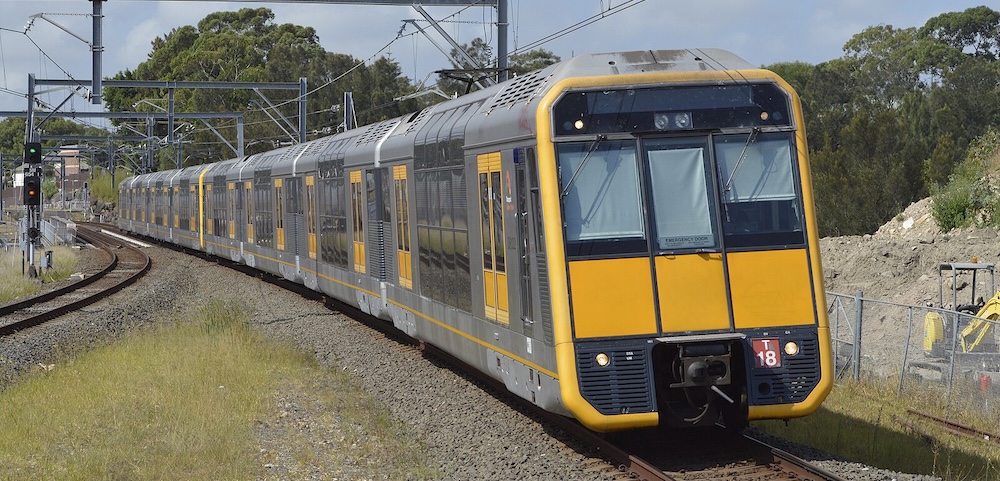
Image: Wikimedia Commons
The state government has unveiled the highly anticipated first refurbished Tangara Sydney train, marking the start of a $447 million overhaul designed to extend the life of a fleet on its last legs, with the expectation of increasing rail manufacturing jobs. This eight-car set was completed at Sydney Trains’ Flemington and Auburn maintenance depots, with 54 more sets to follow over the next three years.
This renewed train fleet is part of a plan to rebuild local rail infrastructure and improve reliability on older suburban trains, in response to the Independent Rail Review. Because of its age, Tangaras have often been vandalised and suffer the most from faulty incidents.
“We’re not just fixing trains, we’re fixing a broken system the former Liberal-National Government left us, that sent jobs offshore and cost taxpayers billions,” said Courtney Houssos, Minister for Domestic Manufacturing and Government Procurement. “After more than a decade of ideologically sending jobs and investment offshore, it will take time to rebuild our local manufacturing capacity.”
The Tangara Life Extension Program plans to upgrade a total of 55 eight-car sets over the next three years, extending the fleet’s lifespan to last around 10 years.
“This is a practical example of how we’re working to improve reliability now, while planning for the next generation of locally built trains,” said NSW Premier Chris Minns. “For too long, NSW paid billions for trains built overseas. We’re starting the long process of putting that money back into local workshops, local workers and a rail industry that should never have been dismantled.”
The Independent Rail Review recommendations
The Independent Rail Review urged predictive and condition-based maintenance for Sydney trains. These recommendations included continuous checks in high-wear and high-risk environments, where materials and parts are most often damaged, as well as applying improved practices for visual assessments and potentially using artificial intelligence (AI) to monitor cameras that view the rails and overhead wires.
Additional notes suggest a shift from the Engineering and Maintenance Branch to the Safety, Risk, and Assurance Branch. The shift would centre on making sure there’s compliance with maintenance plans, clearing maintenance backlogs, verifying qualification certifications, following agreed-upon policies, and avoiding cancellations for scheduled track shutdowns to facilitate maintenance.
Regarding the life extension program, Matt Longland, Chief Executive of Sydney Trains, believes a chance needs to be taken for the overall benefit of travellers.
“The Tangaras cover more than six million kms a year but without the life extension works, we risk more trains breaking down which will inconvenience our passengers,
“Our Tangara fleet has been a faithful workhorse for 35 years, and this life extension project will ensure it continues to be a reliable service while our new fleet is built.”
Courtney Houssos also expressed her support for the Life Extension program.
“By investing in projects like this, and committing to building the new fleet locally, we’re delivering world-class rail upgrades and laying the groundwork for a new, locally built suburban fleet.”
“This milestone is about more than trains, it’s about jobs, skills, and rebuilding an industry that should never have been lost.”
‘Local jobs for local people’
Minns has publicly backed the rail initiative in support of the job market’s potential success.
“The Tangara Life Extension Program means more reliable trains for passengers, good jobs for skilled workers and apprentices, and the start of rebuilding a proud rail manufacturing future in this state.”
The Life Extension program is expected to create the prospect of employing 300 people. This initiative is also accompanied by a current hiring push for more than 200 mechanical trades and engineering roles, including apprentices, adding to last year’s staff of 260 rail employees from UGL Unipart, a private rail maintenance company.
“The Tangara Life Extension is a step along the way because it is recruiting hundreds of workers, including many apprentices, who will be able to build their careers here in NSW,” said John Graham, Minister for Transport.
“The Tangara Life Extension program is happening right here in Western Sydney, creating local jobs for local people,” said Member for Auburn Lynda Voltz.
“This is about rebuilding what was lost. The former government sent rail jobs and contracts offshore we’re bringing them back home,” said Minns
Everything you need to know about Sydney’s new & retiring trains
The initial Tangara fleet was built in Newcastle and entered service from 1988 to 1995. During this time, the NSW Government says the fleet covered around 123,000 kilometers per week. Fast forward to 2025, the first Tangara refurbishment completion started, with 54 additional trains scheduled for renewals in the next couple of years.
According to Transport for NSW, the new Mariyung sets have been operating passenger service on the Central Coast & Newcastle Line since 3 December 2024, and on the Blue Mountains Line since 13 October 2025. The South Coast is scheduled to be available in 2026.
The seats on these new Mariyungs feature wider two-by-two seating, and the carriages also have charging ports, dedicated spaces for luggage or bikes, accessible toilets, up-to-date information screens, and CCTV help points.
However, reliable train lines had to be retired due to being out-of-date. The double-deck V-sets, built at Granville by Commonwealth Engineering between 1970 and 1989, were retired after 55 years as Mariyungs in June this year.
The line operated daily from Sydney to the Central Coast since 1970, and to and from Newcastle since 1984. The V-sets had covered around 140 million kilometres before their final Newcastle service.
Transport for NSW has announced that it will begin ordering the refurbished Tangara successor this term, with a minimum of 50 per cent of the new trains to be built locally, as part of a long-term strategy to replace the train fleet by the 2040s and 2050s.
The replacement trains for the Tangara fleet will be released in the 2030s, then by the Millennium and OSCar models in the 2040s, and then by the Waratah A and Waratah B Series Two models in the 2050s.