Street Art Versus Graffiti – Revisited (Naked City)
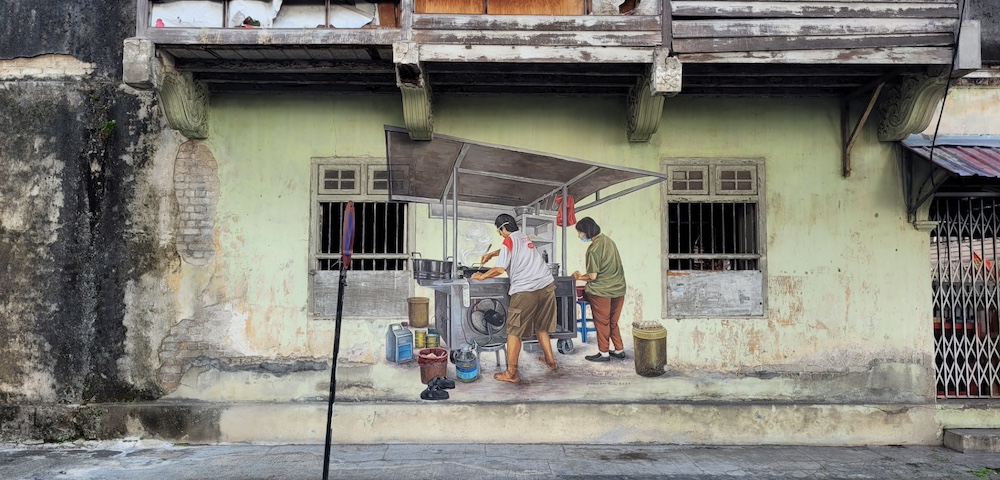
Image: Andrew Liu
In the last two years we have seen anti-Israel, antisemitic and pro-Palestinian slogans sprayed on synagogues and buildings in our capital cities. Most of it is quickly removed, with security cameras in place to deter further attacks. In the meantime, the city and suburbs are awash with all manner of ugly and soulless graffiti and tags.
About eighteen months ago I wrote about this problem and the losing battle that authorities faced in halting the spread. Now it seems they are almost resigned to the visual epidemic. Whether it’s along the railway corridors, inside or outside a suburban train carriage or virtually anywhere that’s immediately visible, you’ll find graffiti or tags. Nothing is sacred with churches, bus shelters, community notice boards, schools, road signs and a multitude of other community assets regularly targeted. State Rail appears to have given up in many areas although perhaps they have run out of the ubiquitous brown paint they once used to cover the graffiti.
Graffiti, as we know it today, is generally considered to have invaded Sydney like fire ants during the 60s, supposedly paralleling an international explosion of rebellious youth subculture. The hip hop style, that first dominated the subways of New York, was soon appropriated for our local streets, albeit an anemic imitation of the real thing. A Puerto Rican friend of mine who visited Sydney a few years ago was quick to suggest ‘white boys can’t spray’ and quickly wrote off nearly all of the local graffiti as ‘baby boy garbage’.
He could be right, as most of the current graffiti looks like a paint by numbers job, boring, repetitive, devoid of any real artistic ability or originality and essentially a form of self-glorification. We’re talking mindless hieroglyphics that say nothing socially or politically and are essentially a slap in the face to the broader community. How about a huge ‘FUCK TRUMP’ hip hoppers or are you afraid you’ll offend Ice-T and Kid Rock?
Surprisingly in Sydney there are now paid classes offered to kids who want to learn how to spray their own masterpiece or personalize their tag. Hopefully they encourage their students not to spray anywhere that might be considered illegal. It’s an interesting phenomenon with the organizers possibly legitimizing what is still generally perceived as an act of public vandalism. I would hope the instruction includes a heavy dose of social responsibility otherwise the critics might say, “what next, a workshop for teens wanting to stage a home invasion”.
Admittedly there are some street illustrators who combine graffiti styles with their own pictorial images, but it’s the giant portrait painters, the muralists, the indigenous landscapers and the political advocates have who made their mark on the walls of this city.
Once again I point to a city where street art is revered by both young and old, in the cultural melting pot of Penang in Malaysia. Throughout the city graffiti as we know it is rare, but the walls of many old buildings are adorned with artwork of everyday life, much loved by locals and visitors alike. Invariably the murals blend in beautifully with the colonial and other historic architecture. Even when the paint begins to peel in the tropical heat they take on an added dimension.The most popular of the murals portrays two young children on a bike, with a real bicycle attached to the wall in Armenian Street. It’s an essential photo op for Penang’s many tourists and is featured on numerous t-shirts, coffee mugs and other souvenirs. In Sydney the same street art would be lucky to last a week, the bicycle would be ripped off and the mural covered in tags. We have no shortage of mindless arseholes.
Most of the street art we see in Sydney, especially around the inner city is legal, sometimes commissioned by councils. At the least it’s ‘semi legal’, springing up on vacant walls and soon becoming an integral part of the community. It’s also much loved like the giant portrait of Adam Goodes in Surry Hills and the long surviving Martin Luther King ‘I Have A Dream’ mural in Newtown.
Maybe what’s needed here is some militancy on the part of the street art movement, painting over the dreary hip hop hieroglyphics with positive images of local heroes and humanity in general. Already we have self-guided and paid guided tours of street art in the inner west and Newtown, a great indication of community support.
Perhaps the final word here should go to the legendary Sydney eccentric Arthur Stace – and that word is ‘Eternity’. If you were around the Sydney CBD or out in the suburbs from 1932 to 1967, chances are you would have come across ‘Eternity’, beautifully inscribed in copperplate writing on footpaths and concrete doorsteps. It was the lifetime mission of former Australian soldier and reformed alcoholic Arthur Stace, following his conversion to Christianity.
The ‘word’ has since been immortalized by artists such as Martin Sharp and Arthur’s life the subject of books, documentaries and even an opera. In light of the current plague of graffiti it should be noted Arthur chose a stick of chalk to leave his message, not a can of spray paint. On a rainy day his pavement evangelism quickly washed off, unlike the ugly scars of modern-day graffiti that often hang around for decades.