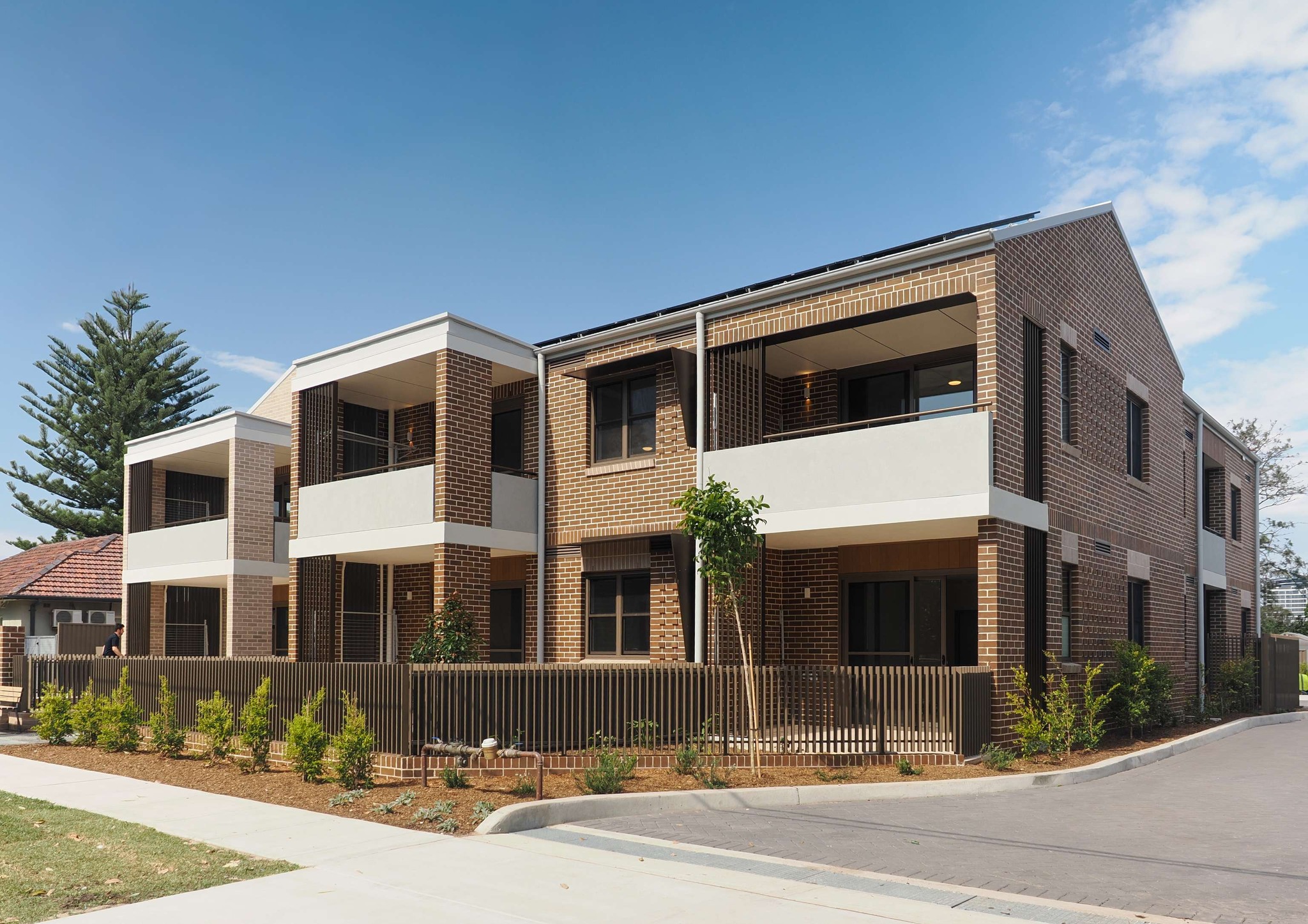
Image: NSW Department of Communities and Justice / Facebook
A prominent research institute has called for Australia’s social housing system to be reformed, whilst the state housing minister has emphasised the number of homes being built.
The Australian Housing and Urban Research Institute (AHURI) released a report in January assessing the state of social housing across the country. Its authors — from the University of Sydney and the Royal Melbourne Institute of Technology — found that, over three decades, modest growth in the total stock of social housing lagged behind population growth.
Overall social housing stock increased from 379,753 dwellings in 1997 to 442,884 in 2023. However, it declined as a proportion of housing in Australia, from 5.2 per cent to 3.9 per cent.
“To date, programs to boost social housing have been sporadic and often customised and complex,” the researchers lamented. “Australia lacks long-term, sustainable social housing growth models.”
Publicly-owned social housing stock has shrunk
Presently, social housing is provided by an array of organisations. It includes public housing managed by state and territory governments, not-for-profit community housing, and that provided through the National Disability Insurance Scheme and the National Rental Affordability Scheme.
This makeup “has emerged through ad hoc policy decisions,” the report says.
“The intention was a system in which public housing stock would sit alongside an expanding stock of community housing. However, this system has generated very little overall growth.”
Publicly owned social housing stock has been reduced, though this is masked by the growth of community housing. The latter is largely a result of stock transferred from public ownership.
It is warned that, without policy change, substantial improvement in supply cannot be expected. “There are no reliably funded targets to increase the rate of social housing provision, given recent sharp increases in housing costs.”
“Current social housing provision models do not cater for the needs of low- to moderate-income households, which are increasingly finding themselves in rent stress.”
AHURI calls for system overhaul
The report says that long-term investment should be combined with policies focused on “achieving area-based growth targets, addressing existing needs and addressing the backlog in social housing.”
Greater oversight is also called for.
“Australian social housing providers often make a surplus. These surpluses should fund long-term growth — not pay for high-cost private finance.”
“With suitable regulation, surpluses from the operation of social housing provision can contribute equity to be used to grow new social housing stock.”
Minister spruiks investments
New South Wales housing minister Rose Jackon told the City Hub that the Minns Government “is delivering the largest investment in social housing in our state’s history.”
“Through our $6.6 billion Building Homes for NSW program, we are taking decisive action to tackle the housing crisis and provide safe, secure homes for those who need them most. This record investment will deliver 8,400 new social homes, and upgrade more than 30,000 existing public homes across the state.”
Jackson added that, in the program’s first 15 months, 1,954 social and affordable homes were built — “the largest uplift in more than a decade, meaning more than 3000 more people now have a safe place to call home.”
“But this is about more than bricks and mortar. Our Homes for NSW Strategy 2025–2035 sets out a long-term, customer-focused roadmap to transform the way we deliver housing.”
The minister said that the Government is “modernising application processes, improving maintenance and ensuring homes are high-quality, accessible, and sustainable, including exploring innovative construction methods to speed up delivery.”
“Every investment we make is about giving people the dignity and security they deserve.”