
New Bill Sees Local Councils Given Power To Reduce E-Bike Clutter
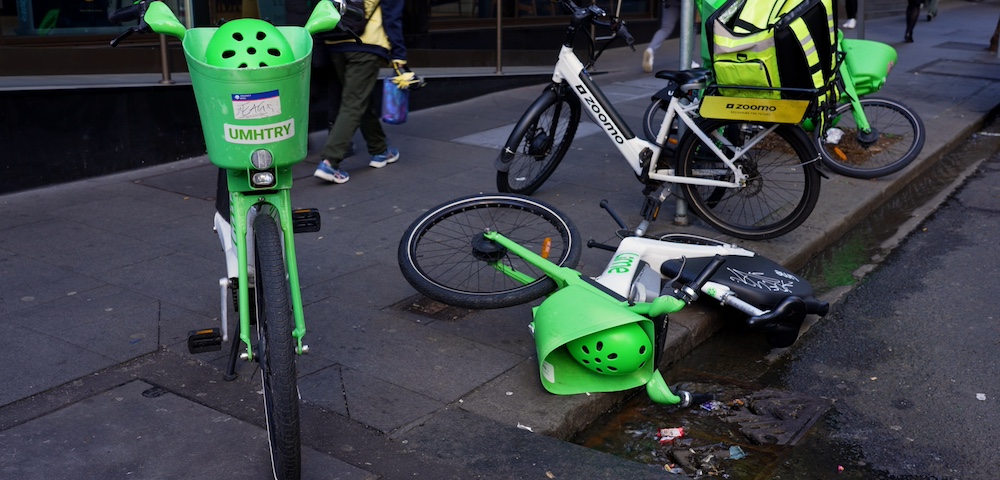
Image: Supplied
Discarded e-bikes on Sydney footpaths will be a thing of the past thanks to a landmark bill being introduced to state parliament today.
In an Australian first, new e-bike shared scheme regulation laws will see local councils given the power to decide where e-bike companies can operate, as well as the ability to establish marked parking, go-slow, and no-go areas.
The legislation comes following months of in-depth consultation with councils, operators and user groups, and recommendations from the Parliamentary Inquiry into the use of e-scooters, e-bikes and related mobility options.
Currently, operators are able to deploy e-bikes anywhere, without approval from councils or the state government, leading to clutter through poorly parked e-bikes, bikes without helmets
Minister for Transport John Graham said the the scheme laws would clean up the clutter and provide clear, consistent standards for operators and local councils.
“We know shared e-bikes reduce congestion, connect our transport system and reduce emissions but the current voluntary approach to parking and safety isn’t working,” he said. “That’s why we’re stepping in to fix the clutter on footpaths and ensure safety standards are met.
“The popularity of shared devices is growing in NSW, in the last financial year alone the number of daily trips increased by 200% and these reforms will help ensure this mode of transport is a safe and accessible option to move around, while balancing the needs of the wider community.”
Operators will also need to pay a fee to fund the scheme, with Transport and councils able to issue fees to who fail to meet the minimum standards, and revoke approvals of operators who breach the requirements. Operators that fail to comply with a removal order face a maximum penalty of $55,000 plus $5500 for each day the offence continues, with those that fail to comply with requests for information facing a maximum penalty of $110,000.
Significant pool of riders only expected to grow
Secretary of Transport Josh Murray said the latest data from Transport for NSW showed 15 per cent of people in NSW have ridden a shared or rented e-bike, with 6 per cent riding at least monthly.
“While this number is likely to grow rapidly, we need to address the impact of poorly parked devices, including access to buildings and footpaths which can present challenges for everyone – but particularly impacts people with prams, elderly people and people with mobility needs,” he said.
“These reforms will give Transport for NSW and councils the necessary powers to ensure shared e-bikes meet safety standards, people are wearing helmets and the issue of dumped e-bikes on footpaths is fixed.”
The new legislation will see operators required to provide helmets, and organise the distribution and collection of bikes, as well as give local councils the ability to to establish parking bays in town centres, train and metro stations.
“This legislation is about creating a clear, consistent framework that allows shared bikes to thrive as part of our active transport network — safely and sustainably,” said Parliamentary secretary, Marjorie O’Neill.
“We want to see these schemes grow and succeed, but in a way that works for everyone, whether you’re a rider, a pedestrian, or a local business.”
Last month, the government introduced a ban on “converted” e-bikes– regular pedal bikes fitted with a motor and battery- on Sydney trails, citing the fire risk from the lithium-ion batteries.
“The overwhelming message from the consultation was that banning all e-bikes from trains would go too far,” Graham said at the time. “Taking out the highest risk e-bikes is a sensible and balanced step, but we will watch this space very closely and take further action if necessary.”