

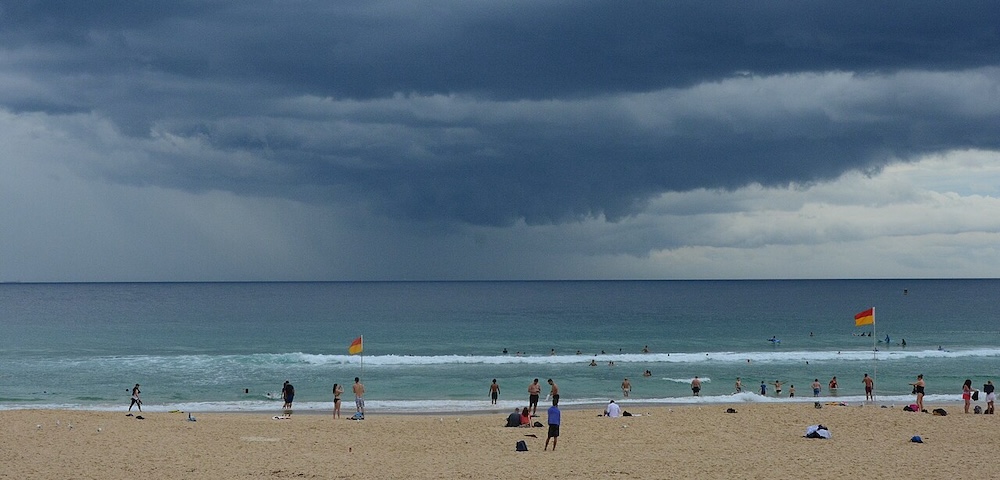
Image: Wikimedia Commons
The findings of last month’s National Climate Risk Assessment have galvanised experts, advocates and MPs, all acknowledging that we must learn to live with a changed climate.
With sobering in-depth analysis, the report highlighted what impacts climate change will and might have on Australia. Some degree of climate change is an inevitability, and so adaptation was emphasised as well as preventative action.
According to its executive summary, the country “is likely to experience more intense and extreme climate hazards,” including in some areas where these have not existed before.
City Hub reached out to some of those concerned to gauge what Sydneysiders, particularly those in the inner suburbs, can expect.
National Climate Risk Assessment: Rising seas & heat are two big risks for Sydney
Professor Martina Linnenluecke, Director of the Centre for Climate Risk and Resilience at the University of Technology, noted that the report identifies “two big risks” facing Sydney.
“Rising seas will put pressure on low-lying coastal suburbs, which increases the risk of flooding and storm surges,” Linnenluecke said. These include Haymarket, Millers Point, Darlinghurst, Darling Point, Double Bay and Kogarah.
“These are areas with significant waterfront developments, which heightens future risks. In the longer term, some may face permanent inundation.”
“At the same time, heat is becoming a serious health issue. The report projects a steep rise in heat-related deaths as summers grow hotter and heatwaves last longer.”
Whereas inundation is a risk for waterside neighbourhoods, the danger posed by increased temperatures is severest in Western Sydney — particularly the Outer West, like Blacktown.
“Contributing factors include inland location, less tree cover and higher density, which drive hotter conditions than on the coast. By contrast, more affluent suburbs benefit from sea breezes and greener surrounds, which lowers their exposure and highlights the uneven distribution of heat risks across the city.”
Councils in the region have sought to increase tree cover, also known as the urban canopy.
NSW “one of the biggest culprits”
Balmain MP Kobi Shetty said that the report “paints a bleak picture for Australia’s future if the Government fails to drastically reduce our carbon emissions.”
The Greens member said that there has already been “a significant increase in climate-fuelled disasters in recent years, and this report warns there’s more to come” without immediate action.
“This alarming report should have been a wake-up call for the Federal Government who need to set reduction targets in line with what climate scientists have been saying for years, which is that Australia needs to aim for net-zero by 2035, with a 75 percent reduction being the absolute minimum required to avoid catastrophic impacts.”
A newly-adopted target seeks to reduce emissions by between 62 and 70 percent by 2035. Shetty called this “an incredibly disappointing response that fails our local communities.”
“The failure of the Federal Government to drive reform puts the pressure back on the states and territories to do more, particularly New South Wales which is one of the biggest culprits when it comes to emissions.”
New South Wales has a bipartisan 2035 commitment to reduce emissions by 70 percent, and has made progress towards this goal.
Shetty said that coal and gas should be left in the ground, renewable infrastructure prioritised, and planning laws updated “to ensure we’re delivering homes that are climate-ready and fit for a much warmer future.”
Locally, this is key for new developments such as those slated for Parramatta Road, she said.
New infrastructure must accommodate climate
Advocacy group Climate Change Balmain-Rozelle is also concerned. “Our most vulnerable residents are in rented, poorly-insulated accommodation, or on the streets,” they said.
The group suggested that the Inner West Council could erect “cooling stations” as part of its response, and that “tree planting for shade should be part of every development, however small.”
They said that all infrastructure works must be future-proofed. “If governments at any level aren’t thinking about climate change as they design and commit to new projects, they have their heads in the sand.”
“While fossil fuel producers rake in profits – and pay little tax – communities are already paying the cost of extreme weather events. Our old drainage systems can’t cope with massive rainfall, for example, and insurance claims for storm-damaged roofs are pushing up premiums.”
To compensate for climate change impacts including on the cost of living, the group advocated “a climate damage compensation levy on the predominantly foreign-owned corporations” which export fossil fuels.







Leave the coal and gas in the ground and the car in the garage. Build Shady bike boulevards everywhere. Can start with a bike path in Callan Park under the trees along Balmain Rd, somehow omitted in the latest Plan of Management.