
Glebe Wins The Dubious Honour Of Being The Most Radioactive Suburb In Sydney
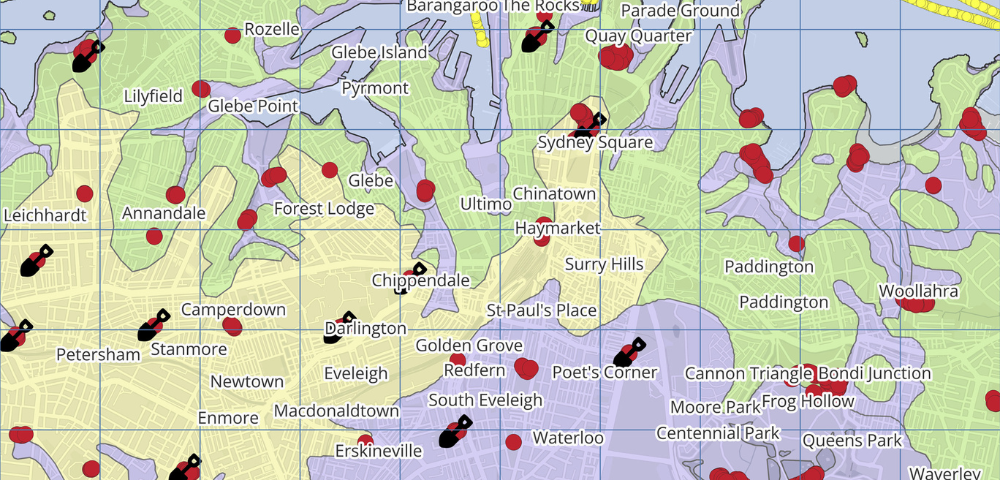
Image: Source: Manenti et al, Journal of Environmental Radioactivity.
Radiation in the soil of the Sydney suburbs sounds like it’s going to turn us all into Godzilla, but according to experts it’s actually normal and harmless.
Milan-born experimental particle physicist Dr Laura Manenti has created the first map of Sydney’s environmental radioactivity, built from gamma ray readings and soil samples taken across the city to quantify the energy emanating from radioactive minerals in the rocks beneath our feet. And Sydney’s (radioactive) hotspot is the bustling suburb of Glebe.
The map shows that the ground beneath the city is constantly emitting a small amount of natural radiation – it’s nothing to worry about. Glebe and its surrounds have a relatively elevated level of background radiation, but even at the highest levels are well within safety limits.
The project was born after Dr Manenti returned from working in Abu Dhabi after getting hired by the University of Sydney, and noticed that her portable gamma ray detector was going “comparatively berserk” in her new office.
“In my office, I have something like 10 counts a second. In my lab in Abu Dhabi, I used to see 0.5 counts a second. So the radiation here was much, much higher than I was used to,” Manenti said.
She searched for maps of Sydney’s background radiation, similar to those available across much of Europe, but found none – so resolved to create one herself. The first-of-its-kind project could lead to better understanding of where a radioactive gas – which can sometimes represent a cancer risk – can seep up from the ground and accumulate in homes and workplaces, and could one day help measure contamination from future nuclear accidents.
The highest “dose rate” of radioactivity found around Glebe is due to the sandstone and shale deep in the ground, that hold higher levels of uranium and thorium. The lowest radiation was found around Centennial Park. The research team believes the underlying geology accounts for 98 per cent of the radiation they detected.
As Dr Manenti says in The Conversation: “Measuring radiation replaces fear with context. It doesn’t make the world more dangerous – it makes it clearer.”

Leave a Reply