
Frank Gehry, Giant of Modern Architecture Behind Sydney’s ‘Paper Bag’, Dies At 96
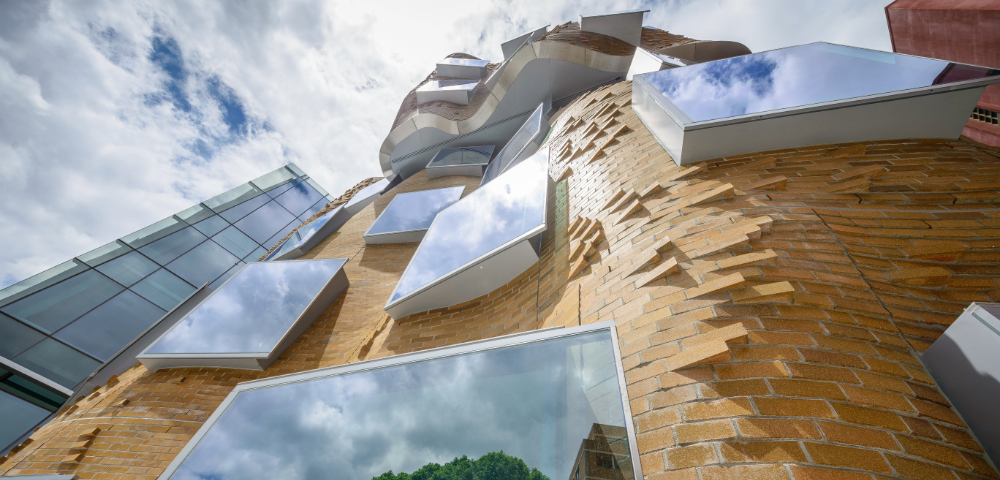
Image: Outside view of Frank Gehry's Dr Chau Chak Wing Building for the UTS Business School in Sydney. Source: Wikimedia Commons
Frank Gehry, the world-renowned architect behind some of the world’s most striking buildings, including the University of Technology Sydney’s landmark Dr Chau Chak Wing Building, has died at 96.
Gehry passed away on Friday morning at his home in Santa Monica after a brief respiratory illness, according to his firm.
His death closes a career that reshaped modern architecture and left a lasting mark on Sydney with the widely-known ‘paper bag’ building.
While the world associated Gehry with monumental works such as the Guggenheim in Bilbao or the Walt Disney Concert Hall in Los Angeles, Sydney occupies a distinct corner in his portfolio. His 2015 UTS Business School Building became his first and only Australian project, dividing opinion on arrival.
Its rippling brickwork and warped silhouette drew comparison to everything from a crushed paper bag to a cluster of treehouses. Today, it stands among the city’s most recognisable pieces of contemporary design.
View this post on Instagram
Gehry first outlined the concept to a UTS audience, explaining that “free association” led him to make a vertical “treehouse” that encouraged interaction rather than isolation. “Silo thinking is the basis in our world,” he said at the unveiling. “How do you break that down so people are interacting?”
For Gehry, the answer lived in the organic logic of branching, tree-like forms.
The project turned an unassuming corner of Ultimo into an international architectural curiosity. Built on the former Dairy Farmers site beside the UTS Library and the ABC, it helped anchor the university’s billion-dollar redevelopment and now serves thousands of students and staff each year.
City of Sydney planning director Graham Jahn praised the design at the time as “one of the best masterplans around”.
Gehry’s maximalist buildings often provoked strong reactions, and he rarely shied away from the conversation. Critics accused his designs of prioritising spectacle over function, a charge he occasionally met with defiance.
Yet even when defending his most polarising buildings, he insisted on pushing architecture toward play, experiment and emotional reach.
View this post on Instagram
Over seven decades, Gehry spanned continents and mediums, from museums and concert halls to jewellery, furniture and even a sculptural hat worn by Lady Gaga. He received architecture’s highest honour, the Pritzker Prize, in 1989 and continued shaping skylines well into his later years.
His influence lives on in landmark buildings across the world, including in Ultimo where the ‘paper bag’ still stands as a provocation. Frank Gehry may be gone, but his challenge to think differently about what design can be remains.