

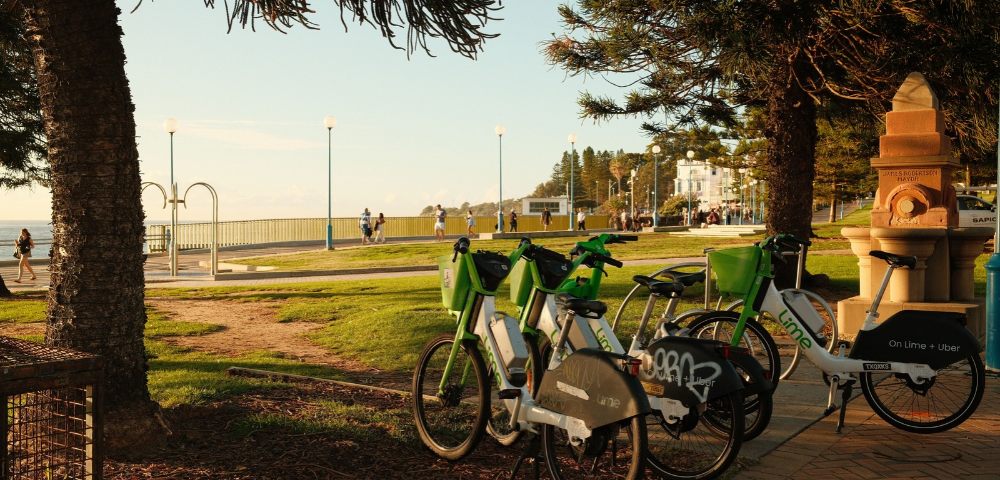
Image: Talha Resitoglu/Pexel
The City of Sydney Council has announced plans to cap shared e-bike fleets in the city, culling 42% of current bikes to reduce street clutter and improve pedestrian safety.
From March 2027, the council plans to cap shared bike fleet numbers to 7,000 bikes in the inner city and reduce availability to two operators. Operators will need to obtain approval from Transport for NSW and councils before deploying bikes in LGAs.
In September, there were approximately 12,000 share bikes on streets across Sydney city. Three companies currently service the area: HelloRide, Lime and Ario.
Capping fleets aims to minimise the impacts associated with shared bike parking, matching the fleet with availability of parking supply, usage figures and a desire to keep competition in the market.
“The cap strikes a balance between maintaining our public domain and ensuring the schemes are successful,” Lord Mayor Clover Moore told City Hub.
“Given how far technology has come, we expect that many of the dispensed bikes will be older, often damaged or graffitied bikes.”
“Share bikes are an important part of Sydney’s transport network, but it’s clear fleet sizes are well in excess of Sydney’s requirements, leaving many bikes unused and contributing to clutter,” she told the Sydney Morning Herald.
Clutter arises from competition and “lack of regulation”
Councillor Adam Worling, Chair of the Local Pedestrian, Cycling, Traffic Calming and Transport Forum, pointed to competition between shared bike operators in Sydney as the “fundamental problem,” leading to “three companies flooding our city.”
“In the process, pedestrians are not winning, shared bike companies are winning.”
“I get it. If you’ve got a pram, or a mobility issue, if you’re elderly and need a clean path of travel, shared bikes can be a big issue,” Councillor Worling empathised with community concerns.
“We must also look after people on our footpaths, and reduce the clutter that has arisen from a lack of regulation,” Lord Mayor Clover Moore told City Hub.
A long battle for shared e-bike regulation
Lord Mayor Clover Moore has been calling on the State Government to regulate shared e-bikes since 2017. “Councils have had no power under law to set or enforce operations, and bikes don’t stop at our boundaries.”
In February, the NSW Government proposed an e-micromobility sharing scheme reform in February 2026, which the City of Sydney Council held did not adequately target the risks of ongoing clutter, frustration and repeated community calls for intervention.
In August, the NSW Government “finally accepted responsibility and issued new regulations,” which asked councils “to prepare local “Operator Conditions”, and set a cap on the number of operators and bikes allowed in their area,” Lord Mayor Clover Moore said. As part of these reforms, Transport for NSW will consider each council’s nominated target and decide on the maximum number of bikes to be made available in the LGA.
Clover Moore is sceptical, but optimistic. “The Government’s regulations, including these caps, won’t solve all the problems the community is experiencing – they need to go further to stop people parking in the middle of the footpath and they don’t offer any guidance about whether Councils will have a role in enforcement, such as issuing fines or removing bikes.”
“But the regulations are a step forward, and we will continue to push for them to be even better.”
Designated parking bays an importance piece of the puzzle
“While we were waiting on the Government to act, we started building designated bike parking areas. We’ve delivered nearly 300 and they’re already helping,” Lord Mayor Clover Moore said.
Councillor Worling reiterated that “shared bikes are a State Government responsibility.”
He held that the Council is using their jurisdiction to clean up shared bike “clutter,” seeking “stronger regulations from the State Government to give [the Council] the authority to move bikes and to insist that bikes are parked in the right area.”
Getting as many shared bike parking areas up and running to adequately execute government caps is a council priority.
The City of Sydney is aiming to roll out Micromobility Parking Bays to combat parking concerns and is expecting there will be over 400 MP bays operational by June 2027, a 90% increase from September numbers. Parking will focus on utilising on-road space, to ensure that shared bikes are kept off the footpaths. Possibilities include utilising “no stopping zones” and converting unused car-share parking spaces.
He maintained that shared bike parking is temporary.
“If we find, over time, that the data shows that people don’t need one in that area, we may move [parking spaces] on.”
The City of Sydney can work with shared bike operators to get locational data, “find out where people need to be, and where they want to pick up [their bikes] from.”
City of Sydney supports shared e-bikes
The City of Sydney holds that they support shared e-bikes and don’t want them removed entirely.
The capped fleet target aims to strike a balance between the impacts of share bike parking to community, footpaths and the public domain. The plan intends to provide conditions where shared bikes are continued to be a useful and attractive part of transport system, and where shared bike providers can feasibly operate in a well-regulated and sustainable system.
“Share bikes are incredibly popular and have become a key part of our transport mix,” said Lord Mayor Clover Moore.
Councillor Worling noted the convenience and speed of shared bikes, “there is no transport that can get me [to my destination] faster.”
Last month alone, almost 700,000 trips were taken across the City of Sydney, with 1.5 million km travelled.







Leave a Reply