Image: Photo: Wikimedia Commons / Instagram
A double standard that affects women has been exposed after a woman visiting a Sydney hotel was told to “cover up.”
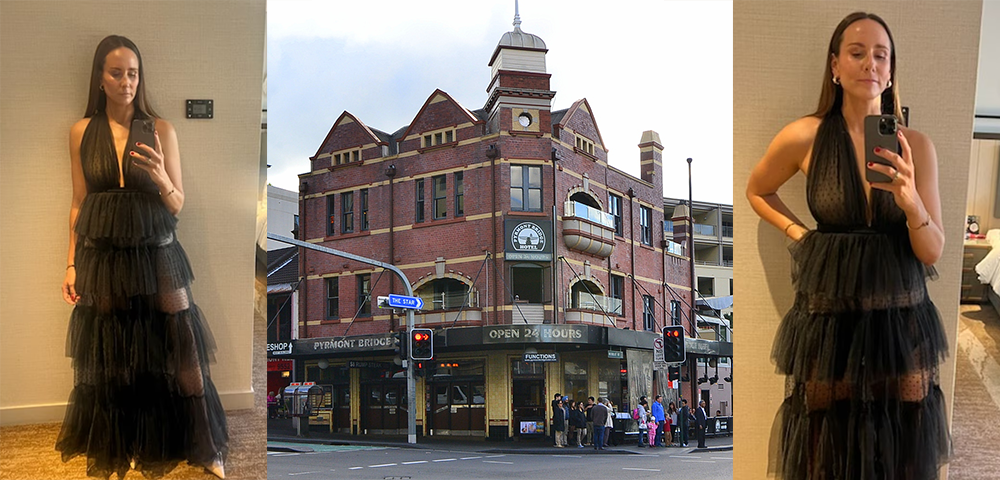
Sydney resident Joey Hespe, 39, visited The Pyrmont Bridge Hotel with a group of friends, who were on their way home after attending a black-tie event.
Wearing an elegant floor-length black ruffled gown, trying to have a simple drink at the pub left Hespe feeling “unsafe” and “sexualised”. She says that comments made about her appearance showcased the reality of the sexualisation that Australian women experience in their day-to-day life.
“I had to cover myself up so that the men could control themselves,” Hespe said.
As she entered the Pyrmont hotel, Hespe says security guards checked the her ID and remarked, “You can go in, but you can’t take your jacket off.”
“I asked him to repeat himself and he said my dress was ‘see-through’ and ‘against dress code’. In that moment, I froze. My body was being scrutinised and sexualised, while at the same time I was told to cover it up.”
“It left me humiliated, confused, and angry – a mix of objectification and control that women know all too well,” says Hespe.
After leaving the security area, Hespe noticed a man wearing a Bonds singlet.
“It struck me how blatant the double standard was: women are told to cover up, while men are free to wear whatever they want,” she explained.
“Aside from the fact that my dress was not see-through, there were just a few sheer panels on the legs, that feeling of being simultaneously objectified and suppressed in the same moment was horrible.”
Pyrmont Bridge Hotel: cover up direction ‘not supported by management’
The Pyrmont Bridge Hotel has a 24-hour licence and has the reputation for being one of the late-night venues in the CBD.
General Manager Andrew McDonald told Newscorp, “On entry the patron was asked by a guard to keep her jacket on, to cover the transparent strips in her dress.”
“We have a relaxed approach to dress code and welcome everyone from tradies to brides and grooms on a weekly basis. His direction is not supported by management or hotel policy.
McDonald said it was “unexpected and out of character for our contracted security team and does not represent the values of the Hotel or our commitment to inclusiveness, equality, and respect for personal expression”.
Women share similar stories, spotlight reality for Australian women
Sherele Moody, a leading femicide researcher and media advocate for families impacted by femicide, took to social media to comment about the reality that Australian women face.
“Excuse me, [Pyrmont Bridge Hotel], but what part of [Hespe’s] dress is inappropriate? No really. What part? Is it too long, too black, too froo-froo [sic] – or is that (shock-horror) a little bit of skin can be seen?” Moody posted to Instagram.
View this post on Instagram
Many of her followers shared their own similar experiences, generating conversations that validated Hespe’s experience.
“I’ve worn this exact dress into this exact venue only a year ago, so it absolute has nothing to do with any kind of dress code, and absolutely everything to do with one man’s deplorable behaviour,” wrote one commenter.
“Excuse me.. what year is this..?? And why are we still telling women what to wear. This says far more about the security guard that it does about her,” wrote another.
One commenter pointed out that attempts to create safer spaces also ends up with complaints: “Usually the bar code is proper closed shoes and no motorbike helmets. Now we’re policing women’s bodies? At a pub? But if we made a women’s only pub, they’d have a whinge. We literally can’t win.”
Another commenter suggested the hotel “needs to get over itself, and just pour bloody schooners. Sacking the security provider for one that displays professional standards might also be a good idea.”
+78% of Australian women have experienced sexual harassment in a public space
Over 78 per cent of Australian women have reported experiencing sexual harassment within a public space. and 76 per cent of people have witnessed sexual harassment in public spaces.
Some of the forms of harassment include:
- Inappropriate and unwanted sexual looks, gestures, staring or leering that makes you feel uncomfortable
- Sexually suggestive or intrusive comments or jokes about your appearance, clothing, anatomy or looks
- Somebody repeatedly whistling, catcalling, making kissing sounds, howling or smacking lips in a sexual way
- Someone being intrusive and insisting to know my name, phone number or any personal information, or pressuring to get a date
- Being inappropriately and repeatedly referred to as a girl, hunk, doll, babe or chick, or insulted
- And more
Data retrieved by the Australian Sexual Offence Statistics (ASOS) collection notes that more than 2.2 million women have experienced sexual violence since the age of 15.
City Hub reached out to The Pyrmont Bridge Hotel but did not receive a response by time of publication.