
78ers Speak Out On Reliving “Horrors” Of ’78 After Seeing Police Violence At Herzog Rallies
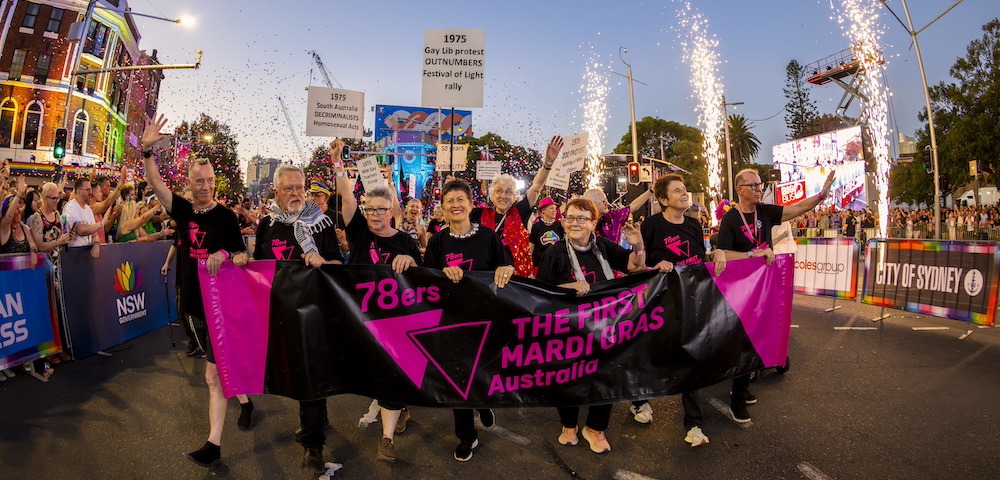
Image: Ash Penin
Members of the 78ers have voiced their concern over alleged police violence at Sydney’s Herzog protest, saying it was akin to the behaviour they saw in the 1978 Mardi Gras.
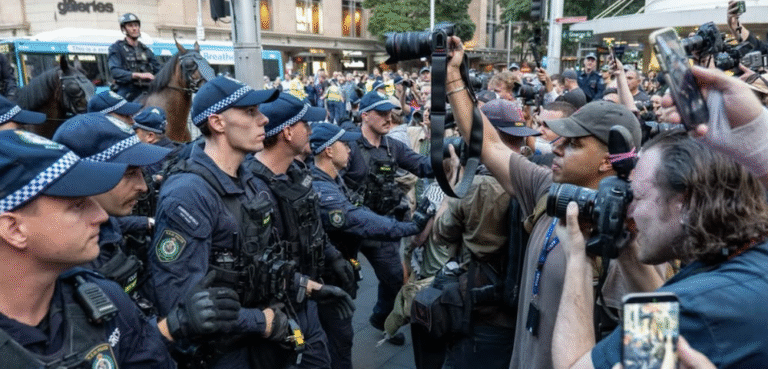
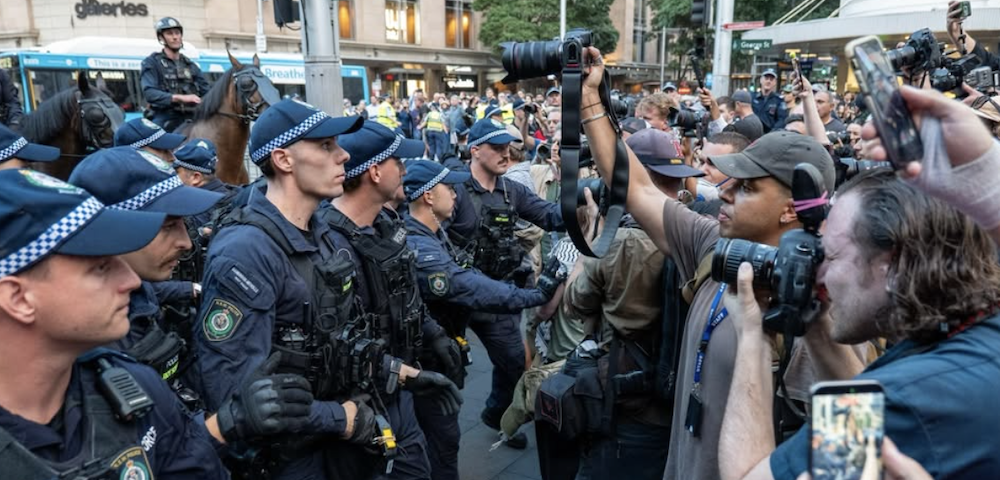
27 people were arrested and dozens injured at the protest against Israeli President Isaac Herzog on Monday, with footage taken on the night appearing to show police officers punching protesters, using pepper spray indiscriminately, and forcefully dragging a group of Muslim men kneeling to pray.
Earlier this week, members of the 78ers, Mark Gillespie, Graham Chuck, Steve Warren, Meredith Knight, Peter de Waal, and Peter Murphy joined the call for an independent investigation into police behaviour, with the Law Enforcement Conduct Commission (LECC) announcing their intent to review the matter on Friday morning.
“We know the power of protest and how vital it is to strengthen our democratic society,” the 78ers said in a statement. “Therefore we must condemn the NSW Premier and the Police Commissioner for political repression and violence against the anti-genocide and pro-Palestine movement in Sydney that we witnessed this week.”
An elder of the LGBTQIA+ community and foundation member of CAMP, de Waal, said Monday’s scenes were a brutal reminder of rampant police violence at the first Mardi Gras, where 53 people were arrested, many getting bashed in the cells at Darlinghurst Police Station afterwards.
“I found myself reliving 24 June 1978 — the horrors, violence, and trauma inflicted by police on the 78ers that night,” he said. “Those memories are not history to me; they are part of my life. Seeing and hearing what unfolded stirred emotions I had hoped never to experience again, yet they returned with a painful clarity.”
NSW Premier Chris Minns said police had done “everything possible” to avoid confrontation on the night of the protest, but were left with no choice after protesters defied restrictions preventing them from marching to NSW parliament, put in place after the Bondi Beach terror attack.
“The circumstances leading to the confrontation are incredibly important. And perhaps even more important than that is the fact that NSW Police and the government did everything possible to avoid a confrontation last night in the middle of Sydney,” he said on Sunrise on Tuesday morning.
“Now what’s not shown on the videos because it didn’t happen, is what would have happened if protesters had breached police lines in the middle of Sydney, it would have been chaos, even worse than the scenes that were reported on the news.”
Calls to reconsider NSW Police’s Mardi Gras invitation
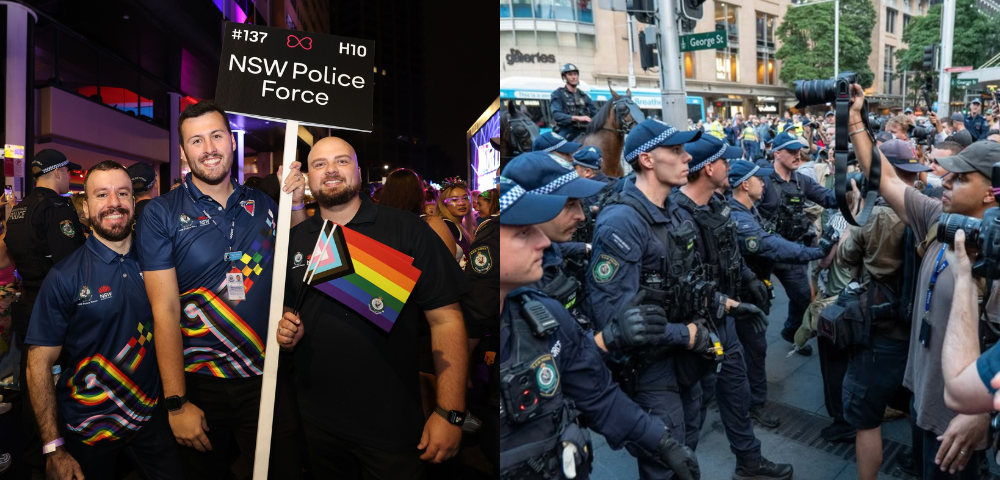
It comes as members of the LGBTQIA+ community call for Sydney Gay and Lesbian Mardi Gras organisers to reconsider their invitation to the NSW Police and NSW Labor party to take part in the festivities.
Malyangapa and Barkindji man and former First Nations Advisor to Mardi Gras & Sydney World Pride 2023, Keith Quayle, said that the violence seen on Monday was a reminder to many that state sanctioned violence will always be defended by the government.
“This violence took place in the same parts of the city in 1978 where police once chased terrified gay men, lesbian women and trans folk through the streets, beat them, arrested them, and locked them up for just being who they were,” he said. “Those acts destroyed lives. Some of the people who lived through that violence are still here. Some are not. The ground we walk on carries that memory.
“For Aboriginal people, queer people of colour, trans and gender-diverse people, sex workers, and those who have been hurt by police before, this is not abstract. Police presence is not symbolic. It is not reassuring. It brings fear, hyper-vigilance, and exclusion into a space that is meant to be about survival, pride, and collective care. It brings up old and new wounds.”
Although police involvement in Mardi Gras has been a contentious issue for years, Monday’s protest took place only days out from the beginning of the festival’s 2026 program, throwing the involvement of an institution like the police under the spotlight.
“After all of these events, it’s very important to distinguish between the police, the premier, the senior officers, and the individual police, especially the LGBTQI police,” 78er Murphy told City Hub. “They have no role in making decisions in operations like that, and I haven’t talked to any of them about that night. I don’t know whether many of them were there or not, but the importance of their inclusion in the parade is really a separate issue altogether.
“We need to really build more and more support for our community and show the whole of society that we are a really vibrant, positive part of society, if we’re ever to really neutralise the threats that are coming towards us from the Trumps, the Putins, and their really extremist supporters in Australia. I can assure you now those extremist supporters are not in the New South Wales Police Force.”
Both the NSW Police and NSW Labor have been invited to be a part of the 48th Mardi Gras Parade, and will have stalls at Fair Day this weekend.
State officials continue to stand by police actions
Assistant Commissioner Peter McKenna said he was “very proud of the police officers” and stood by their actions in the face of “outrageous behaviour”.
“I absolutely think police actions were justified,” he said.
“I saw the restraint of police tonight. They took more than their time before they utilised any of their powers.
“It was really quite precarious at times for our officers, who were significantly outnumbered by the protesters and the people who wanted to act in a violent and offensive manner.”


Leave a Reply